This year my theme is Connection. And for this, I’ve started laying the groundwork. Just like in the second half of 2018, I’ve been keeping up my updates on the Timeline.
One big thing I’ve done is to follow a course on ‘The Molecular Mechanisms of Ageing‘. The course was quite detailed and I’ve learned some more fundamentals of ageing. I hope to use this knowledge further in a later part of this year.
I’ve also followed a course on JavaScript from Codeacademy. The course was quite enlightening, now I should/will start using it (and future courses on PHP and other tools) to upgrade my website, workflows (e.g. toggl-google calendar link), and Queal Dashboard/website.
One other actionable was to start using more ‘book’ knowledge in real-life and at Queal, we’ve been implementing two books into our routines. One about Building a Storybrand, and the other about usability testing (Rocket Surgery Made Easy).
Here is my analysis of the goals and various updates:
Goal 1: Make this website a true personal knowledge hub
I’ve added almost all of my back-catalogue from before moving the website over. I’ve also done the same from another wiki-like system I used. Of course, I haven’t yet written all the blogs/reviews I wanted to write.
The goal stays the same and in the coming quarter, I hope to improve search and continue to add new things to the Timeline, reviews, etc. Maybe I will write a long essay, but no guarantees.
Goal 2: Eat good meals that support my well-being 90% of the time
Yes and no. For most meals I eat at home, I’ve made them myself and have put some effort into it. I do see that I eat quite a lot and that includes quite some yoghurt with toppings at work.
I will keep being conscious of this and with Lotte moving in, I think my food will be very good. I might even bring some more to the office (and have some variety next to 2-3 meals of Queal per day).
Goal 3: Keep on improving my house
Yes. I’ve done quite a lot since last writing here. The bathroom is finished (for which I only did the door and painting). I take a bath about once a week and of course it’s very convenient to have a toilet upstairs.
Next to that, Lotte is moving in soon (in a few days of writing this draft, and on the day of publishing) so we’ve been making the house even cooler in the meantime.
The plants have multiplied, we’ve painted some walls, there is a new couch, new bookshelves/library, etc. I like how everything looks and Lotte will take some time to sort out her things.
One other addition is ‘Anne’, the robot vacuum (from iRobot) and he is working quite well. Today I put away all cables he was messing up, so he should be all good to go.
Goal 4: Achieve my fitness goals
The last few weeks I’ve been following my own new plan and that is going very well. I don’t know yet what I can do best in terms of weight-loss versus muscle-gain, but everything looks good for now.
I’m still learning the Snatch and better my Clean & Jerk. I haven’t measured my max yet (will do so in about 7 weeks) and who knows I will be a bit closer to the 90kg.
“Bob Johansson has just sold his software company and is looking forward to a life of leisure. There are places to go, books to read, and movies to watch. So it’s a little unfair when he gets himself killed crossing the street.
Bob wakes up a century later to find that corpsicles have been declared to be without rights, and he is now the property of the state. He has been uploaded into computer hardware and is slated to be the controlling AI in an interstellar probe looking for habitable planets. The stakes are high: no less than the first claim to entire worlds. If he declines the honor, he’ll be switched off, and they’ll try again with someone else. If he accepts, he becomes a prime target. There are at least three other countries trying to get their own probes launched first, and they play dirty.
The safest place for Bob is in space, heading away from Earth at top speed. Or so he thinks. Because the universe is full of nasties, and trespassers make them mad – very mad.”
This was a fun story and makes me wonder about the second and third book in the ‘bobiverse‘. I do however think that the story structure was different from what I expected so let’s take a look:
Hmm I do realise that there is a short storyloop at the beginning:
You: Bob, sold his company, etc
Need: to live, and well, you’ve been hit by a bus
Go: you are an AI and you need to figure out how this works
Search: learn to work with the tools you have. Learn more about the world
Find (with the help of a guide): learns how to protect himself, use his new abilities
Take: has to leave the world, and leave all his connections to the world behind
Return: finds his humanity again in VR etc (and returns to Earth to save it later)
Change: he is the new Bob (and Bill, Homer, etc)
You: Bob, AI, cruising through space
Need: to survive from other AIs humans made (but a lot of new goals and subplots are introduced later, and there I think the story might be less good, but also interesting, hmm)
Go: on the way to new resources in other solar systems
Search: energy, place to be safe, make copies, learn skills
Find (with the help of a guide): arrives in other solar system(s), has new skills, improves, finds way to save humanity (after a while at least) (hmm, not really a guide here except from some old knowledge of tv series etc, and some quotes from The Art of War)
Take: not all Bobs survive, humanity? (but not really, because you don’t really care about that too much) (I guess there could/should have been more sacrifice?)
Return: populates the universe, goes back to Earth
Change: he is the new Bob (and Bill, Homer, etc)
I guess another problem I had with the story structure was the lack of closed loops. The threat of the Brazilian probe is still there, there is another type of intelligent civilisation out there (that took the metal out of one system and left some bots there), the humanoids on another planet (and the gorilla’s etc they have to survive from), etc.
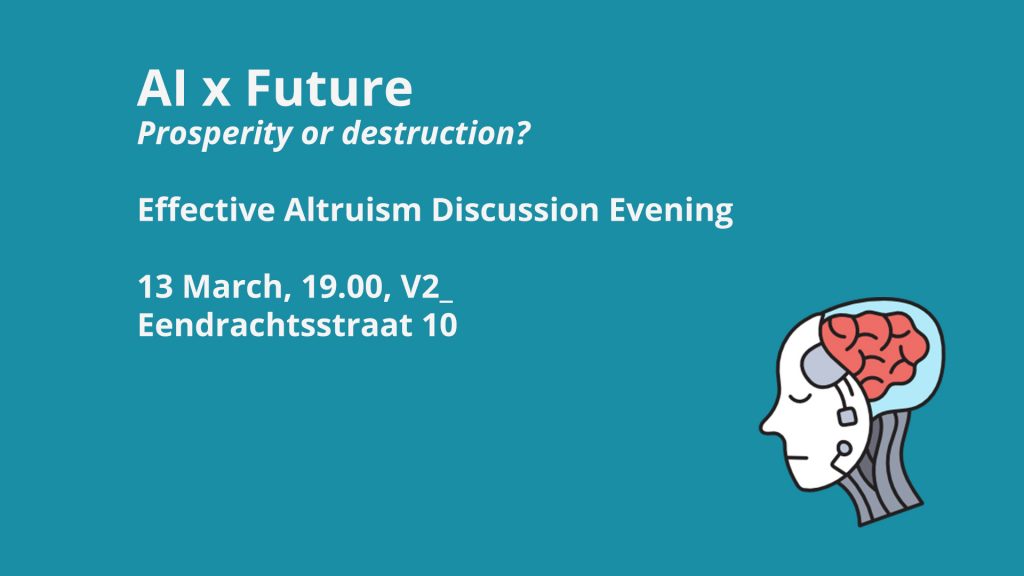
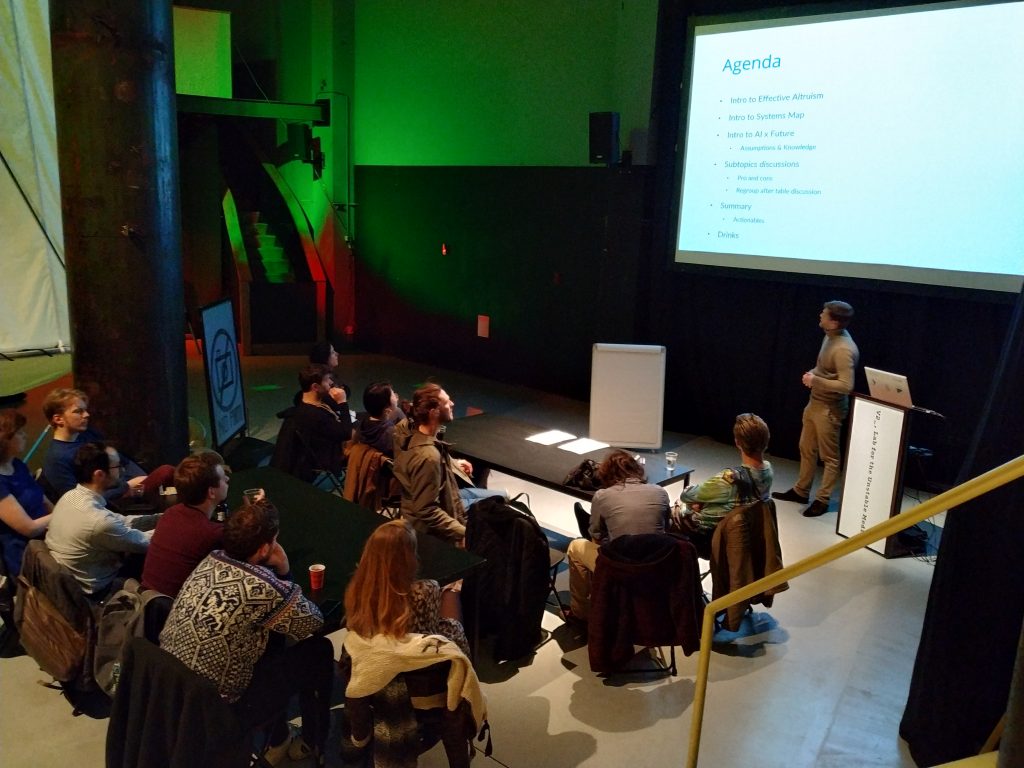
On Wednesday 13rd of March 2019, the EA Rotterdam group had their seventh reading & discussion group. This is a deeper dive into some of the EA topics.
The topic for this event was AI x Future: Prosperity or destruction?
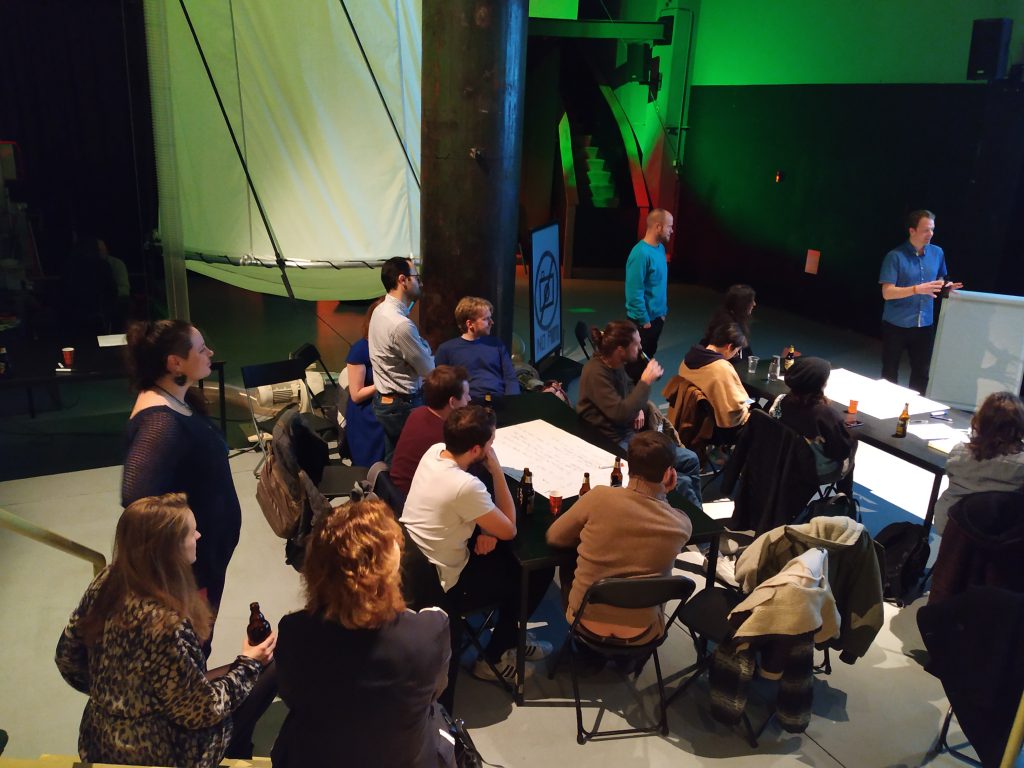
During the evening we discussed how artificial intelligence (AI) could lead to a wide range of possible futures. First we gave a presentation about the field (and what it’s future might bring). After that, we split the group in 3 parts and discussed the possible positive and negative outcomes.
Although we gave the instruction of thinking about only one side, of course all 3 groups also considered the opposite point of view from what they had to argue. Here are the questions, presentations, and my personal summary of the night.
We (the organisers of EA Rotterdam) thank Alex from V2_ (our venue for the night) for hosting us, and Jan (also from V2_) for being our AI expert for the evening.
If you want to visit an EA Rotterdam event, visit our Meetup page.
Questions
These were our starting questions:
Bright Lights
What could AI do for you personally (if AI did/solved X, I could now Y)?
What could be the effect of AI on energy production? Could AI help prevent/solve/reverse climate change?
What effect could AI have if fully implemented in health research (protein folding, cancer research, Alzheimer’s)?
Could AI help us produce the food we need with fewer resources (new crops, cultured meat, fewer pesticides, etc)?
How would mobility change with self-driving cars, trucks, buses, planes?
Could we prevent crime from happening (e.g. intelligent camera’s, prediction algorithms)?
Can AI actually improve our privacy?
Can we work together with AI to create more together (e.g. chess teams a few years back, a doctor working with AI image system)?
Will AI make wars obsolete? Or when they happen, more humane?
Could AI fight loneliness (e.g. robots in nursing homes)?
Could AI help us learn and remember better (e.g. a ‘smarter’ Duolingo)?
Will AI be conscious? If yes, could it ‘experience’ unlimited amounts of happiness?
Dark Despair
Will there be any jobs for us to do in the (near/long-term) future? What can’t AI do?
Who will enjoy the economic benefits from AI (Google/Facebook shareholders)? Will life become even more unequal than ever before in history?
Could someone hack the autonomous cars of the future?
Will we live in a totalitarian (China/Minority Report) state enabled by AI?
Does AI mean the end of privacy (everything tracked and analysed)?
Will AI enable more gruesome warfare (more weapons, no-one at the button)?
Will we lose contact with each other / lose our humanity (e.g. robots in nursing homes, chatbots (in Japan))?
What if the goals of the AI don’t align with our (humanity) goals? Can we still turn it off? How could we even align these goals – philosophy hasn’t really figured this one out yet!?
Will AI be conscious? If no, will there still be humans to ‘experience’ the future?
Bonus:
What are some concrete (future) examples of AI destroying the world?
Can you think of some counter-arguments for the points you expect the other group to raise?
Write down the date your group thinks AGI will happen? (don’t show the other team)
AI x Future
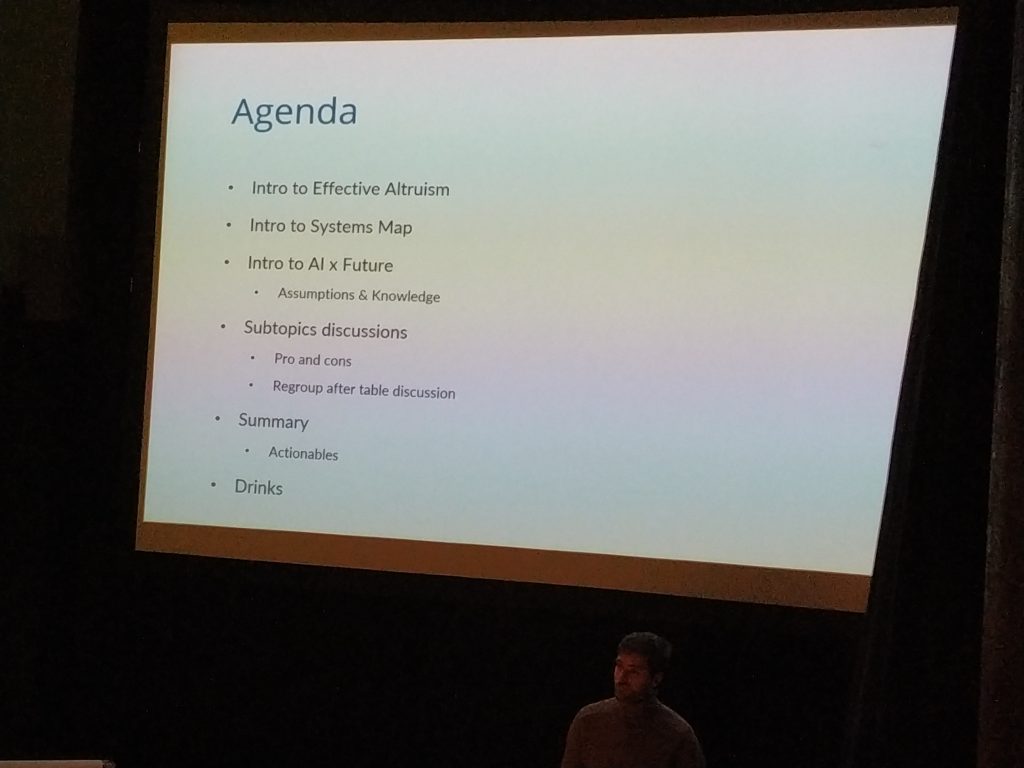
We started the evening with a presentation by Christiaan and Floris (me). In it, we explained both Effective Altruism (EA) and how (through this framework) we look at AI.
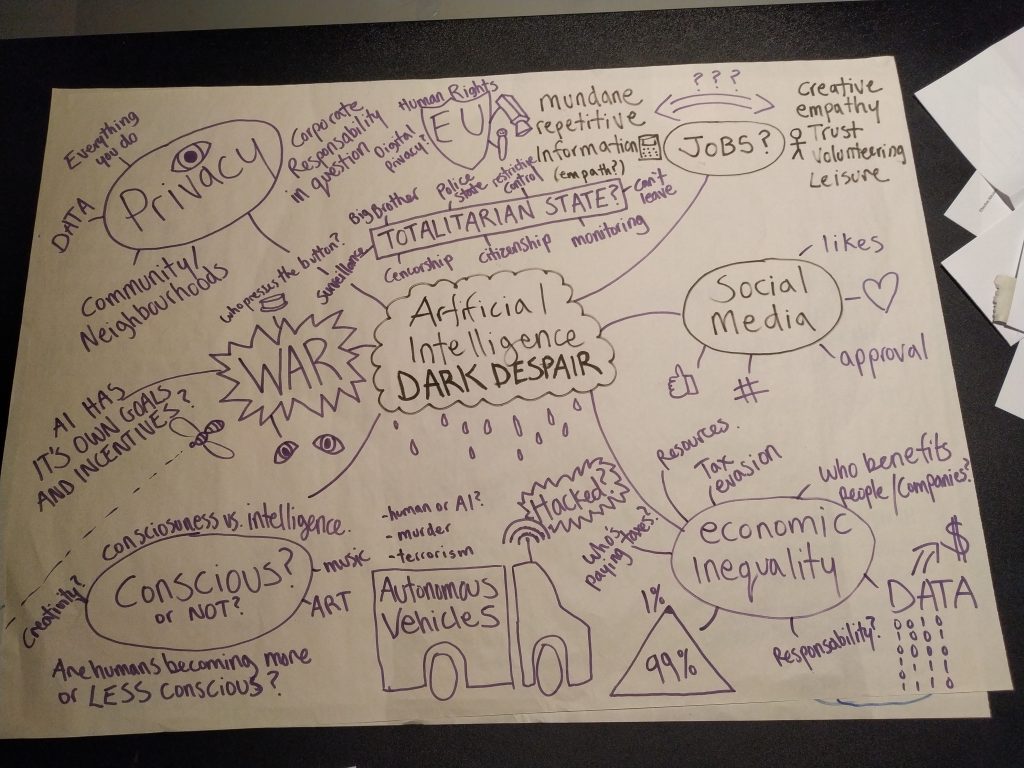
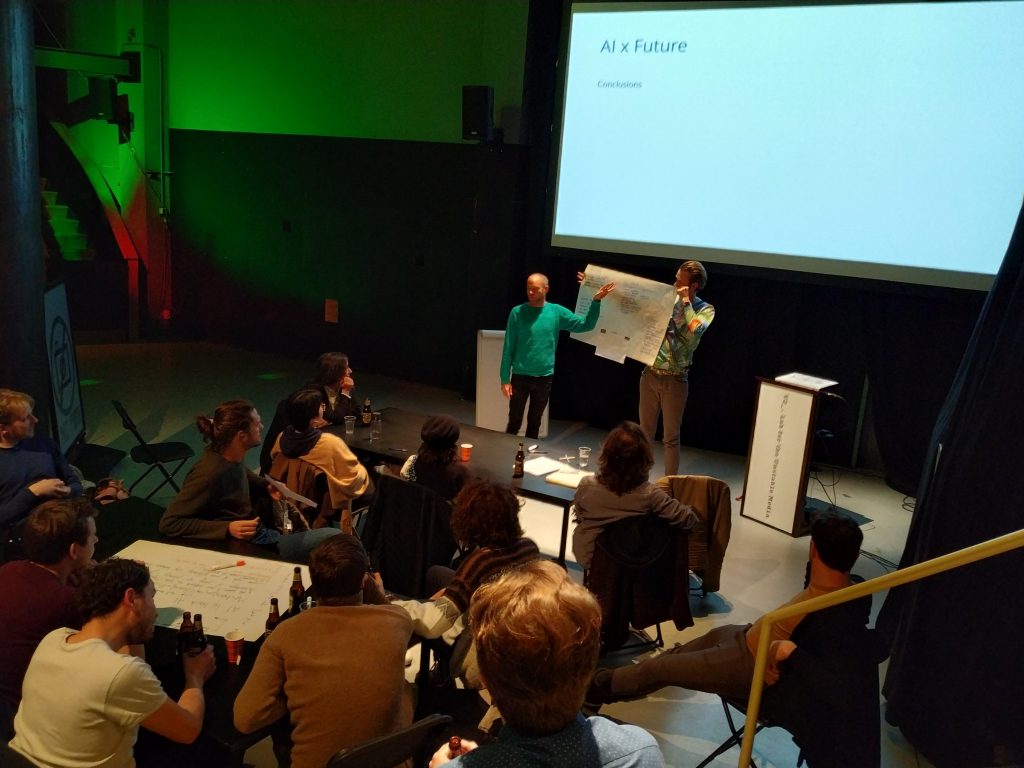
After that, we split the group into two and both groups worked on making a mindmap/overview of the questions asked above (download them). This is a summary of both sides:
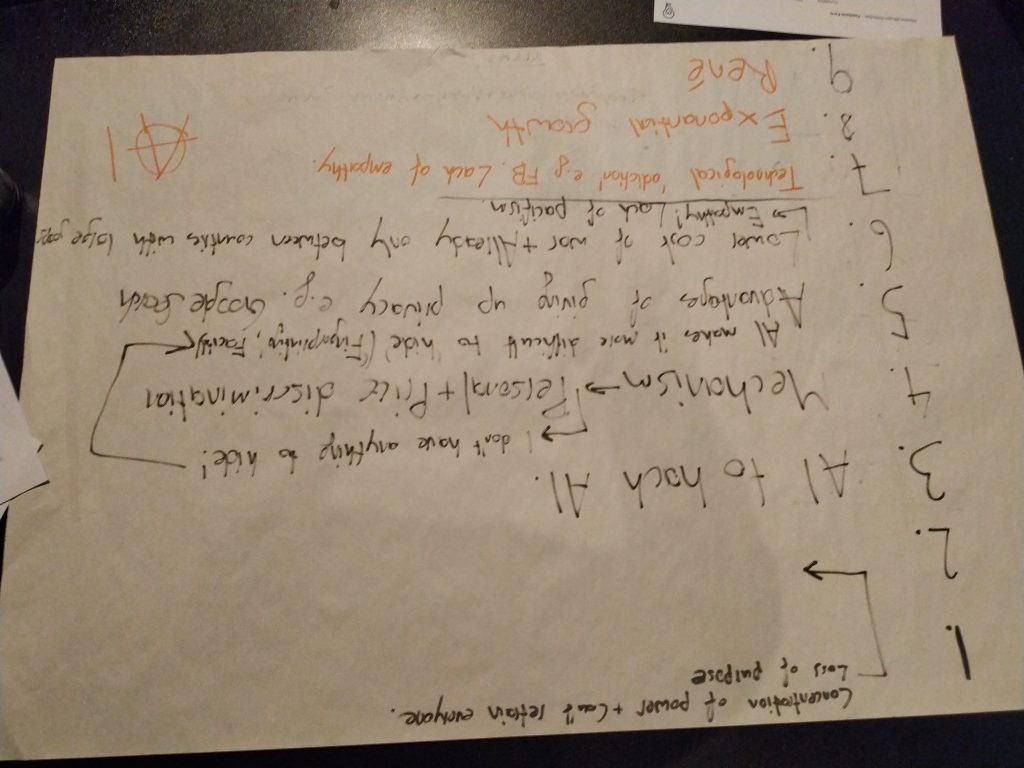
Group 1&2 – Dark Despair
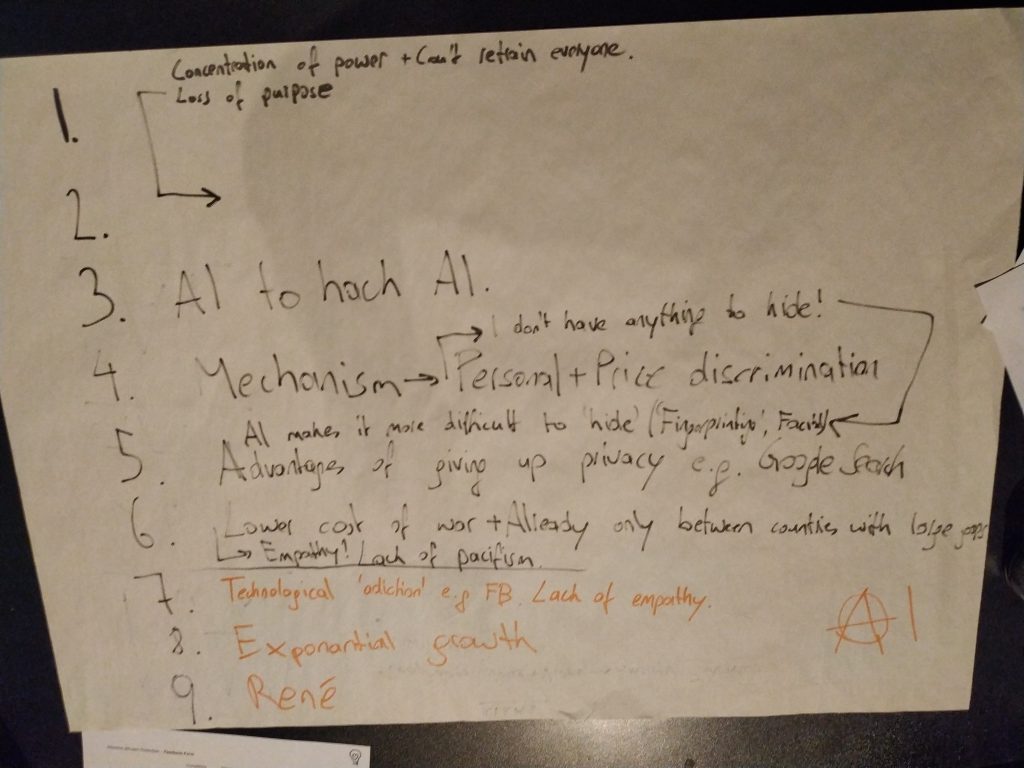
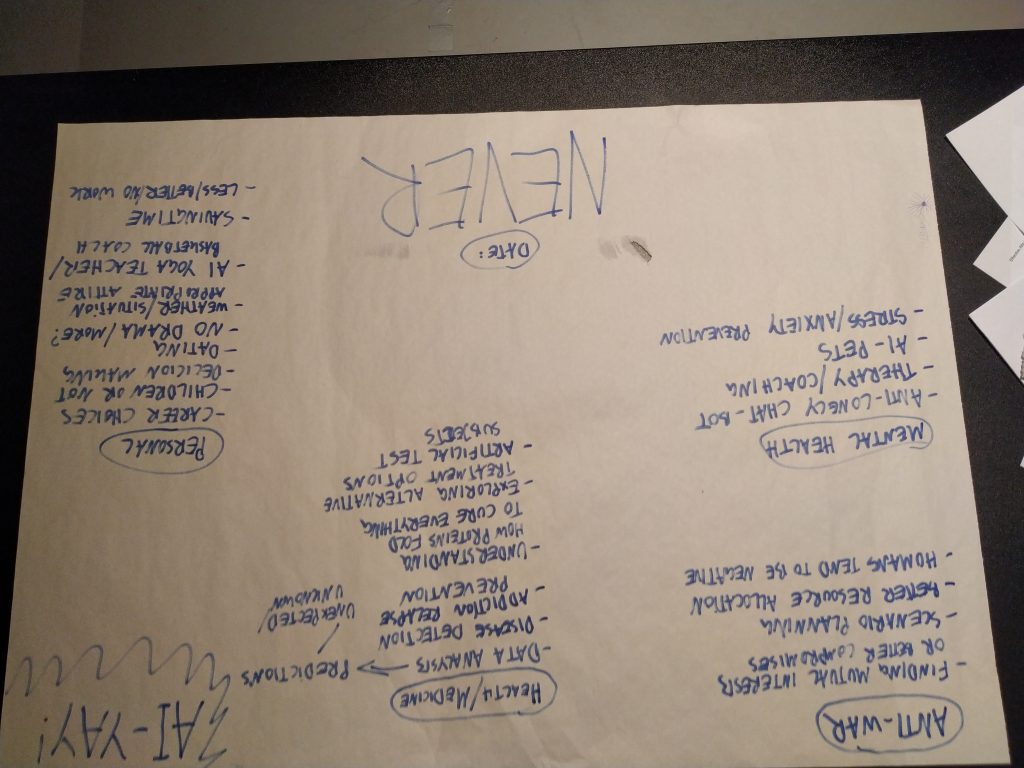
These are the two posters from the Dark Despair groups:
Privacy
In a world with AGI, it could possibly track everything you do. The data that is is disparate systems could be combined and acted upon (not in your interest). Think 1984. You won’t be able to hide, your face will be detected.
Totalitarian State
This leads right into the second point of despair, a totalitarian state. One where big brother is always watching. The EU is making a case for privacy and human rights, can they withstand AGI?
Censorship, like that in China already this day, could lead to total control of the population. You might not be able to leave (e.g. if you’re social credits are too low).
War
Killer bees, but this time for real (or well, artificial, with tiny bombs). It is already real and warfare can become more dangerous and one-sided with an AGI on one side of the battle. Who presses the button? And are the goals of the AGI the same ones as ours?
And what if this makes war cheaper? Instead of training a soldier for years at millions of costs, just fly in some (small) drones that control themselves. Heck, what if they can repair themselves?
Will there be any empathy left in war? If you’re not there, why see the other side as a real human?
Jobs
Will there be any jobs left? A(G)I might leave us without mundane and repetitive tasks (a positive in most cases), but what about creative jobs, jobs that need empathy and give you meaning? Some say that A(narrow)I of today is already taking jobs here (e.g. Woebot).
And for who would we be working? Will it be to better humanity or for furthering the goals of the AGI (which might not align with ours).
Social Media
Looking closer at home, learning algorithms (ANI) are already influencing our lives and optimising our time on social networks, making us hunker for likes, hearts, approval. What if Facebook (social media), Amazon (buy this now, watch Twitch), Google (watch Youtube), Netflix, etc. become even better at this? Will we be the fat people from Wall-E?
Economic Inequality
And whilst we’re binge-watching some awesome new series, the AGI is hacking away at tax evasion (which some people are already good at, image the possibilities for an AGI).
Where will the benefits go? Do they go to society (like now via taxes and positive externalities) or will companies (and their executives) rake in all the benefits? With more and more data, who will benefit? How will the benefits ‘trickle-down’?
Autonomous Vehicles
In many US states, truck driver is the single largest job category. What if this disappears? What if the cars get hacked? Who is responsible when an accident happens (which is, of course, less likely, but hey we’re not the positive team here). (more on Self-Driving Cars at WIRED).
Consciousness
Consciousness and intelligence don’t go hand in hand. Will AGI enjoy art, music, or anything at all? And (surprising to me), we asked, are humans becoming less conscious?
AGI vs AGI
What if you take the time to program the safety into your AGI, and then the other team (read: country) doesn’t and their AGI becomes more intelligent faster, but doesn’t share our goals? Guess who ‘wins’.
Group 3 – Bright Lights (AI-YAY!)
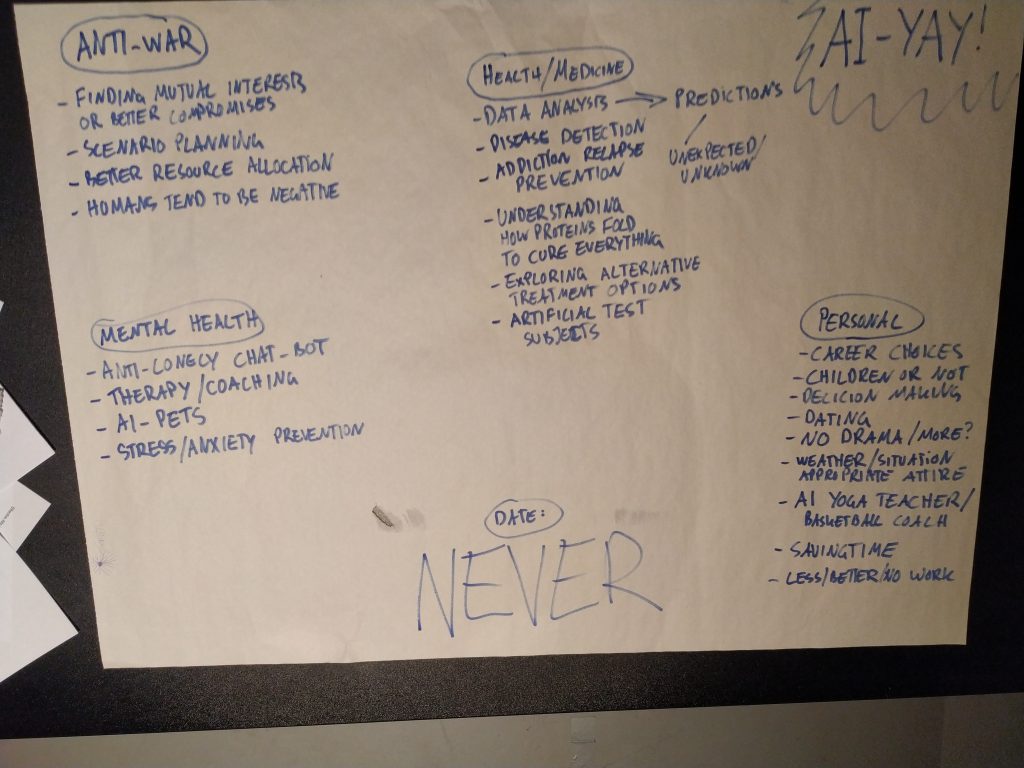
This is the poster from the Bright Lights group.
Anti-War
AGI could find better compromises and mutual interests. If you could plan scenarios better (show losses from war, have shorter wars, show benefits from cooperating, etc). We pesky humans tend to be quite negative, what if AGI could show us that war is not needed to achieve our goals?
War is, a lot of times, about resources. But with AGI we should have abundant resources, so no more war? (to read more about war, check out my summary of Better Angels of Our Nature by Steven Pinker).
Health/Medicine
With better data analysis, we can make better predictions and make better medicine. We can see the unpredicted/unknown and intervene before it’s too late.
We can help people who are addicted to prevent relapse. Data from cheap trackers could help someone stay clean. It could even detect bad patterns and help people before things get too bad.
If we understand how proteins fold (and we’re getting better at it, AlphaFold), we might cure every disease we know. The possibilities of AGI and health are endless and exciting.
Mental Health
A chat-bot could keep you company. If we have more old people (before we make them fit again), an AGI could be their companion.
Chat to your AGI and ditch the therapist. Get coaching and live your best life. Not only for people who have access to both right now. No, therapy and coaching for everyone in the world.
Personal
AGI could help you with making life decisions (think dating simulation in Black Mirror). Choose the very best career for your happiness/fulfilment. Should you have children? Dating, NO MORE DRAMA!
Have your AGI tell you the weather. Have it be your personal yoga teacher, your basketball coach. Let it take away boring work, save you time, and let you live your best life.
Conclusion
Two hours isn’t enough to tackle AI and our possible future. But I do hope that we’ve been able to inspire everyone who was there, and all you reading this, of what the possible future’s there are.
“May we live in interesting times” is a quote I find very appropriate for this topic. It can go many ways (and is doing that already). If, and when, we will have AGI, we will see. Until then, I hope to see you at our next Meetup.
Resources
Videos
Nick
Bostrom – What happens when our computers get smarter than we are?
Max Tegmark
– How to get empowered, not overpowered, by AI
Grady Booch
– Don’t fear superintelligent AI
Shyam
Sankar – The rise of human-computer cooperation
Anthony
Goldboom – The jobs we’ll lose to machines — and the ones we won’t (4 min)
Well, not actually a book, a monograph. One that accompanies Good to Great. Turning the Flywheel by Jim Collins goes deeper into the concept of the flywheel. Below I will define the flywheel and give two interpretations of it, for Queal and for myself.
Flywheel
The Flywheel effect is a concept developed in the book Good to Great. No matter how dramatic the end result, good-to-great transformations never happen in one fell swoop. In building a great company or social sector enterprise, there is no single defining action, no grand program, no one killer innovation, no solitary lucky break, no miracle moment. Rather, the process resembles relentlessly pushing a giant, heavy flywheel, turn upon turn, building momentum until a point of breakthrough, and beyond.
7 steps to capturing your own flywheel: 1. Create a list of significant replicable successes your enterprise has achieved. 2. Compile a list of failures and disappointments. 3. Compare the successes to the disappointments and ask, “What do these successes and disappointments tell us about the possible components of our flywheel?” 4. Using the components you’ve identified (keeping it to four to six), sketch the flywheel. 5. If you have more than six components, you’re making it too complicated; consolidate and simplify to capture the essence of the flywheel. 6. Test the flywheel against your list of successes and disappointments. 7. Test the flywheel against the three circles of your Hedgehog Concept
Queal
Create a complete meal
Deliver the best meal experience for quick moments
E.g. good shaker, dashboard, ordering process, etc.
The Gods Themselves by Isaac Asimov consists of three consecutive stories. I like that he started this book as an explanation why plutonium 186 can exists (it can’t, but a friend of his mentioned it and he decided he could write a story about it).
I liked the book and it was an interesting listen. As always it’s very interesting to see what happens when communication breaks down between places (the Moon-Earth, Earth-Panuniverse).
As before, here is the analysis of the story-structure, this time with a guide part added (based on Building a StoryBrand).
You: people on Earth in about the year 2100ish. Or, para-people
Need: energy, after ecologic and economic collapse. Also need energy.
Go: ?. Explain why, what has happened (sun low energy).
Search: have to find new energy source. ditto
Find (with the help of a guide): plutonium 186 from para-men. Way to get energy from other universe (pump), guide is themselves as parentals.
Take: energy imbalance, possibility of world ending, losing position (Lamont). Other universe will die if they continue.
Return: tried to warn everyone. Wants to fix it (but doesn’t really do this).
Change: find new solution, kinda. Finds out they are parental themselves.
Ubik by Philip K. Dick is one of his most acclaimed novels. Whilst listening to the book I did understand this in the beginning. But as the story drags on, I lost a bit of interest and wondered if I missed something significant.
“By the year 1992, humanity has colonized the Moon and psychic powers are common. The protagonist, Joe Chip, is a debt-ridden technician working for Runciter Associates, a “prudence organization” employing “inertials“—people with the ability to negate the powers of telepaths and “precogs”—to enforce the privacy of clients. The company is run by Glen Runciter, assisted by his deceased wife Ella who is kept in a state of “half-life”, a form of cryonic suspension that allows the deceased limited consciousness and ability to communicate. While consulting with Ella, Runciter discovers that her consciousness is being invaded by another half-lifer, Jory Miller.” (wiki)
Interpretations of the book say that Ubik might be about God, or Good and Evil. Hmm, not my cuppa.
“Ubik is a science fiction novel written by Philip K. Dick. It follows the story of Joe Chip, a technician at Runciter Associates. When an explosion kills Joe Chip’s boss, Glen Runciter, strange things begin to happen. Soon Joe realizes his boss did not die in the explosion, but he is in a state of half-life. If he wants to stay that way, he has to keep the evil Jory from eating his life energy.“
These are my detailed notes of the great marketing/storytelling book, Building a Storybrand by Donald Miller.
Section 1: Why most marketing is a money pit
the key to being seen, heard, and understood
the secret weapon that will grow your business
the simple SB7 framework
Section 2: Building your storybrand
a character
has a problem
and meets a guide
who gives them a plan
and calls them to action
that helps them avoid failure
and ends in a success
people want your brand to participate in their transformation
Section 3: Implementing your storybrand brandscript
building a better website
using storybrand to transform company culture
Introduction
Customers don’t care about your story, customers care about their own story!
Chapter 1: The Key to Being Seen, Heard, and Understood
Pretty website don’t sell things, words sell things.
We aren’t just in a race to get products to market, we’re also in a race to communicate why our customers need those products in their lives.
The more simple and predictable the communication, the easier it is for the brain to digest. Story helps because it’s a sense-making mechanism.
Mistake 1: Brands don’t focus on aspect of their offer that will help people survive and thrive.
Focus on what is evolutionary important
Example: we know the exits in a room, not the number of chairs
Tell a story about the ‘exits’ not the number of chairs
Mistake 2: Brands cause their customer to burn too many calories in an effort to understand the message.
If there is too much (useless/non-essential) information, people ignore the brand
The key is to make your company’s message about something that helps the customer survive and to do so in a way that they can understand without burning many calories
Stories have a necessary ambition, defines a challenge, provides a plan to conquer challenges.
This creates a map customers can follow to engage with our products and services.
The formula for movies is the same as will be explained (StoryBrand Framework).
The key is clarity (if you confuse you lose).
Identify: What customers want, what problem we help solve, what life will look like after using product/service.
Noise is the enemy of a business. Clutter that is generated by the business itself.
It was as though he was answering a hundred questions his customers had never asked.
What we think we’re saying to our customers, and what our customers actually hear are two different things. Customers make decisions based on the latter.
The key good writing is what you don’t say.
Chapter 2: The Secret Weapon That Will Grow Your Business
A story is your way to combat/break through the noise.
Example: Music and noise are very similar, but the structure of music makes it memorable.
The essence of branding is to create simple, relevant messages we can repeat over and over so that we “brand” ourselves into the public consciousness.
Example: Lisa computer from Apple, 9 pages (boooring) technical. Later, 2 words (think different). It’s about you.
People buy the products they can understand the fastest.
Story in a nutshell:
A character who wants something encounters a problem, before they can get it. At the peak of their despair, a guide steps into their lives, gives them a plan, and calls them to action. That actions helps them avoid failure and ens in a success.
Examples: stories of Hunger Games, Star Wars
Truly creative and brilliant marketers and screenwriters know how to use the formula while still avoiding cliché.
The three crucial questions (movie):
What does the hero want?
Who or what is opposing the hero getting what she wants?
What will the hero’s life look like if she does (or doesn’t) get what she wants?
Anything that doesn’t serve the plot has to go.
The three crucial questions (brand/website/marketing-material)
What do you offer?
How will it make my life better?
What do I need to do to buy it?
Could a caveman look at your website and immediately grunt/get what you offer?
Example: online camera course, removed jargon and fluff (90% of text), focus on questions above (x5 revenue).
A good filter removes all the stuff that bores our customers and will bear down on the aspects of the brand that will help them survive and thrive.
Chapter 3: The Simple SB7 Framework
Principles:
The customer is the hero, not your brand
you are the guide (Yoda)
hero wants something
Companies sell solutions to external problems, but customers buy solutions to internal problems
they want to solve a problem that has disrupted their peaceful life
Queal: Time has disappeared? or not eating right anymore, (can’t find the time for it)
Customers aren’t looking for another hero; customers are looking for a guide
brands that position themselves as a hero, unknowingly compete with their potential customers
Customers trust a guide who has a plan
remove confusion about how to do business/take next step
agreement and process plan
Customers do not take action unless they are challenged to take action
Seth Godin: create tension (and/or step 6 too)
there needs to be a reason
characters only take action after they are challenged by an outside force
A call to action involves communicating a clear and direct step our customers can take to overcome their challenge and return to a peaceful life.
direct or transitional
Every human being is trying to avoid a tragic ending
what’s at stake/what happens if you don’t take action
show the cost of not doing business
brands that help customers avoid some kind of negativity in life, engage customers (they define what’s at stake)
use this strategically (like salt, so not too much or none at all)
Never assume people understand how your brand can change their lives. Tell them
if we don’t tell people where we’re taking them, they will choose another brand
offer a vision
mystorybrand.com (use tool to fill in)
Chapter 4: A Character
The customer is the hero, not the brand.
Define the character’s ambition / define what your customer wants.
Can this brand really help me get what I want?
Example: luxury resort changed from pictures about themselves, to focus on luxury for customers.
Example: a hassle-free MBA you can complete after work.
Identify what customer wants, gives definition and direction.
Identify a potential desire, this opens a story gap.
Example: Jason Bourne has amnesia (Wie ben ik godverdomme…)
Finding out what customers want, opens the story gap.
Pair that desire down to a single focus.
Don’t clutter the story by giving the hero (customer) too many ambitions.
Only after the general story, you might want to define subplots
What you define should be related to the customer’s sense of survival.
Survival: primitive desire to be safe, healthy, happy, strong.
Conserving financial resources (Walmart)
Conserving time (Queal, cleaning service)
Building social networks (working at Coolblue? Facebook)
Gaining status (Rolex)
Accumulating resources (Vanguard, many B2B offers)
The innate desire to be generous (EA, vrijwilligers organisaties)
The desire for meaning (ditto, Tony?)
You can tap into multiple motivations of course
The goal for branding should be that every potential customer knows exactly where we want to take them.
Chapter 5: Has a Problem
Companies sell solutions to an external problem, customers buy solutions to internal problems.
The problem is the hook of a story.
The more we talk about the problems our customers experience, the more interest they will have in our brand.
You need a villain, and it doesn’t have to be a person, but needs personified characteristics.
Example: Time management software, villain is distractions.
Villain characteristics:
Root source (time-monster?)
Relate-able
Singular
Real
Three levels of problems.
External problems
real-life/physical barrier between hero and desire for stability
Example: ticking time-bomb, restaurant solves external hunger problem
Internal problems
The purpose of an external problem is to manifest an internal problem.
Movies: Do I have what it takes? (emotions, internal frustration to solve)
Example: Apple, internal frustration of intimidated by technology
Queal: can’t eat right within time/life constraints?
Example: car rental company, frustration of talking to people, automatic check-in
Example: second-hand car sales, not focus on external (need new cheapish car), focus on internal (don’t want to be hussled) (no commissions, clear terms)
Example: Starbucks, deeper sense of feeling well/sophisticated/cool, etc. (ohh and they have ok/good coffee)
Philosophical problems
Why does this matter? (in the grand scheme of things)
Frame the ‘buy now’ button as the action a customer must take to create closure in their story.
Example: Tesla
Villain: Gas guzzling, inferior tech
External: I need (want) a car
Internal: I want to be an early adopter of new tech
Philosophical: My choice of car ought to help save the environment
Chapter 6: And Meets a Guide
Customers aren’t looking for another hero; customers are looking for a guide.
If a hero solves her own problem in a story, the audience will tune out.
A brand that positions itself as a hero is destined to lose.
The day we stop losing sleep over the success of our business and start losing sleep over the success of our customers is the day our business will start growing again.
In stories, the hero is never the strongest character.
The guide has been there, done that.
The guide is the one with the most authority.
The guide is not the centre, he simply plays a role.
Those who realise the epic story of life is not about them but actually about the people around them somehow win in the end.
Empathy
“I feel your pain”
Understanding the struggle the customer has.
Make sure that you tell customers you care!
Show that you have something in common with the customer.
Authority / Competence
Customer wants to check off box in back of mind, give confidence in your ability that you can help them.
Do it (indirectly) via:
Testimonials: Let others do the talking for you. (3 testimonials)
Statistics: left-brain, emotional-number (link to benefit)
Awards: awards your company has won
Logos: B2B, other businesses you’ve worked with, B2C news-outlets
“Can I trust this person?” (empathy) / “Can I respect this person?” (competence)
Chapter 7: Who Gives Them a Plan
Customers trust a guide who has a plan.
Commitment (buying) is risky for customer, he can lose something.
What if it doesn’t work? What if I’m a fool for buying this?
Remove much of the risk, increase their comfort level.
This is the plan.
Create clarity
Remove sense of risk
The plan tightens the focus of the movie and gives the hero a ‘path of hope’ she can walk that might lead to the resolution of her troubles.
What do you want me (the customer) to do now?
The fact that we want them to place an order is not enough information to motivate them.
A process plan describes the steps a customer needs to take to a) buy our products, and/or b) use the product after they have bought it.
A plan alleviates confusion for our customers.
The amount of steps in a plan should be at least 3 – max 6.
A agreement plan is about alleviating fears.
When you do business with us, we agree to ABC.
This clarifies shared values between customers and us.
Agreement plan usually works in the background.
Give your plan a name.
“easy installation plan”
“your morning plan”, “you good mornings plan/meals”
Titling your plan will frame it in the customer’s mind and increases the perceived value of all that your brand offers.
Chapter 8: And Calls Them to Action
Customers don’t take action unless they are challenged to take action.
Ask them to place an order.
Heroes/customers need to be challenged by outside forces (to take action).
One of the biggest hindrances to business success is that we think customers can read our minds.
Repeat the ‘buy now’ button throughout the website (make it very obvious how to take action).
E.g. Storybrand website has a ‘register now’ button
Off all customers they worked with, none had too many calls to action (overselling is not an issue)
When we try to sell passively, we communicate a lack of belief in our product.
The guide must be direct with the hero about what they want them to do.
Direct call to action (buy now, make appointment)
Transitional call to action (download pdf, webinar, usually free)
Stake a claim to your territory (show that you’re the leader in the industry)
Entropy, plainly defined is a lack of order or predictability or gradual decline into disorder. Entropy in our world is ever increasing, with the following framework, I will explain why.
Entropy
Entropy is a measure of disorder in a system. If for instance, your room is really tidy and organized, there is little entropy. When everything is laying around everywhere, there is a lot of entropy. In other instanced entropy is used to describe the lack of predictability or order, the decline into disorder. The above framework states that over time information increases, I will argue why information is equal to entropy, how these concepts are related, and why it is increasing.
Arrow of Time
My argument starts with the arrow of time, the travel from past to future. We cannot (in most cases) predict the future, but we can look back into the past. We can take actions to affect the future, but not the past. And more practically, we can turn eggs into omelettes, not the other way around. The arrow of time defines a distinction between the past and the future, something that is observable throughout the observable universe. Over time information increases in open systems, but lets first see how entropy influences closed systems.
Second Law of Thermodynamics
The second law of thermodynamics states: the entropy of a closed system will (practically) never decrease into the future. If for instance, we have an ice cube in a glass, over time it will dissolve into water. To argue that entropy has increased we only need to look at the arrangement of its molecules. To arrange them to make ice cubes, there are fewer ways of doing so than making the puddle of water. But what about putting the water back into the freezer? Won’t that decrease entropy then? The answer is no, you will burn calories, the freezer turns energy into heat, and overall the entropy in the whole system will increase. Here are some more examples:
Examples
A campfire – the fire and resulting warmth and ash a more dispersed (in terms of energy) than the original wood
The Sun – now a big ball of plasma, it will one day (in the far future) expand and dissipate
You – although your body may reduce entropy in the short term, in the long term your molecules will disperse again
Quantum Mechanics
Why does entropy increase? Why is there more entropy now than right after the Big Bang? Quantum mechanics is probabilistic and every quantum event, therefore, increases the disorder in the universe. Let me explain; there is no way of predicting where an electron is going to be, you only have probabilities where it might be. Therefore if you measure an electron – if you define its position – you add information. But how then is information equal to entropy?
Information is normally associated with order. For example, the tidy room can easily give you the information where your shirts are, or in which drawer your socks are. For ten different items of clothes, you will have ten points of information. Now consider the messy room, for every different item you have to remember the exact spot, there is no logical relationship between one sock and another. So if you have ten pieces of each different item of clothing, you will have 100 different points of information. Randomness or disorder therefore equal information, and when the one grows the other does too. Along the arrow of time, entropy and information in the universe increase.
When to Use
What does this mean for us mere humans? Should we embrace entropy and aim for as much information as possible? My answer is no. When you have a maximum amount of information, you will not necessarily have a maximum amount of meaning. Meaning is derived from a balance of order and entropy. This is why we people use models/frameworks/theories, to order information and at the same time leave room for randomness. This is where I believe we receive the most value and can learn the most.
On an ending note, I love that quantum measurement is not predictable. It means that we cannot predict the future, that all life is not determined before us. As much as we know that entropy will increase, we do not know how and where. We have the power to shape our own future and to use entropy to increase information.
“Entropy isn’t what it used to be.” – Thomas F. Shubnell
“Life is a preparation for the future; and the best preparation for the future is to live as if there were none.” – Albert Einstein
Fredkin’s Paradox states that the smaller the difference between two choices (making the decision less significant), the tougher the decision is to make; below is the associated framework
Paradox
A paradox is a statement that seems to contradict itself, yet might be true. “This statement is false” is an example of the liar paradox, a second paradox type. The statement cannot be true and false at the same time. A proverbial paradox can be the following statement “To be kind, you sometimes have to be cruel”. This third kind of paradox refers to a person that acts in contrary to his character. The last refers to statements that conflict with common belief. Fredkin’s paradox best fits the last category.
Fredkin’s Paradox
Ever stood in the store deciding to have peanut butter with or without chunks for what seemed an eternity? Or have you taken more than an hour finding a flight that is just €10,- cheaper than the alternative? Then you have been exposed to the workings of the Fredkin’s paradox. The paradox states the following “… in a choice situation, as the options become more closely matched on utility, the decision becomes more difficult, but the consequences become less significant”. A decision between jam and peanut butter makes a bigger difference than adding nuts, but in most cases will take people only seconds to decide upon. When people have to decide between similar options, decision time may become longer instead of shorter.
The Curse of Choice
There are two related concepts that intertwine with Fredkin’s paradox, 1) too many options, and 2) cost of not deciding. In a chocolate store, there were more than 100 different kinds of chocolate on display, customers came from far away to see the shop, yet ended up buying only small amounts of chocolate. The shopkeeper could not figure out why people were not buying more chocolate and asked a psychologist to investigate. The psychologist soon found out that the customers were baffled by the number of choices and did not know whether to buy ‘orange dream cream’ or ‘fine peach white chocolate’. So he tried an experiment, setting up in the store a small part in which people could choose between (only) 5 different flavours. Although there was less to choose from (thus reducing the chance people could find their favourite chocolate), people now bought much more chocolate. This paradox can be explained partially by Fredkin’s paradox, and by the fact that people now had to process less information and were thus spending more time buying, and less time deciding.
Not deciding also brings along costs, costs that we might sometime forget to see. In his amusing book Predictably Irrational, Dan Ariely describes how a friend of him decided on buying a camera. He compared brands, he compared prices and eventually came to compare two almost identical models. He studied each detail and eventually picked the one best suited for his needs. Then Ariely asked him about how many photo opportunities he had missed in the last three months whilst he was comparing cameras? We do not get to see the answer, but it sure is more than the advantage of picking one nearly identical model over the other. Fredkin’s paradox not only scoops away time, but the indecision in the meantime also costs you.
Examples
Comparing two cars on the account of one having a cup holder
Fighting over which route to take when both differ in time by only 5 minutes
Deciding between 50 types of Italian ice cream for the next 10 minutes
When to Use
What are we to do with this information you may ask. The takeaway message is to stop worrying about small decisions. Think about the impact the outcomes will have on your life and how insignificant the decision will be in the long run. Even when you are making a truly big decision (e.g. which job to take), do not get lost in details (about vacation days and other benefits), take most or your time to think about the things that make the largest impact (the work you will be doing). Next time you are in the supermarket think about the Fredkin’s paradox and challenge yourself to half the time you spend there.
“We live in an age when unnecessary things are our only necessities.” – Oscar Wilde