
- Sort Blog:
- All
- Book Reviews
- EA Rotterdam
- Essays
- Flotes
- Goals
- Links
- Series
- Short Stories
- Uncategorized
January 1, 2019
Ending Aging
Ending Aging by Aubrey de Grey is one of the more revolutionary books I’ve read ever. It doesn’t just ask the question ‘Can we live forever’? No, it proposes concrete research directions for solving the causes of death.
I currently follow some of the research and it’s amazing to see what has happened in the last 11 years (since 2008). In some time I would very much like to be involved with solving ageing.
Here are some of my notes from the book:
- dedication: “To the tens of millions whose indefinite escape from ageing depends on our actions today”
- Aubrey’s insight was to stop focusing on the (very difficult) problem of metabolism. He just looked at the damage it causes and how to heal that
- All you have to understand is the damage itself. Take that away, take ageing away
- In industrialised countries, more than 90% of people die of ageing (vs homicide, suicide, road accidents, etc)
- “The average person in the industrialised world consumes more health-care resources in his or her last year of life than in an entire life up to that point” (in other words, what if you could keep someone healthy, that seems to save an awful amount of money)
- Aubrey wrote the book to shift public perception. To make ageing the new smoking. To let people think about the possibilities
- He predicts that (from 2008) there is a 50/50 chance of finding solutions to the current ageing diseases by 2038. And that after that we will discover more and more at a rate that is quicker than that things will kill us
- One thing I question is how equally this will be distributed. And at what rate therapies like this will be adopted. But better be sure that I wish to be part of it
- A good point in the book is about diet. I think you should have a good diet, enjoy your food, and eat mostly plants. Aubrey agrees but doesn’t see it as a viable solution to ageing. It might add a few years but that is not what he is after (he has larger ambitions)
- There is no biological limit/barrier of ageing. Our bodies just haven’t evolved the ‘right’ things to survive, because there was no evolutionary pressure to do so (already reproduced).
- Prevention is better than combating the bad outcomes of a bad lifestyle. “Most people leave the serious maintenance of their car [body] until it’s too late”
- SENS (his non-profit) identified 7 ways the body fails with age (and the path forward):
- Cell loss, cell atrophy (cell therapy)
- Junk outside cells (phagocytosis by immune stimulation)
- Crosslinks outside cells (AGE-breaking molecules/enzymes)
- Death-resistant cells (suicide genes, immune stimulation)
- Mitochondrial mutations (allotopic expression of 13 proteins)
- Junk inside cells (transgenic microbial enzymes)
- Nuclear mutations aka cancer (telomerase/ALT gene deletion plus periodic stem cell reseeding)
That is where I will leave it for now. Another day I will talk a bit more about the societal consequences, either here or on a future article on longevity.
December 29, 2018
The Beginning of Infinity
In some books I’m searching for a philosophy of life. Some guidelines, if you can call them that, that direct you to a better life. One that is more ‘true’, makes you happy, adds positive things to the world. This book is definitely one where I think I’ve found a piece of the puzzle.
The Beginning of Infinity by David Deutsch is a book where you get taken on a journey of understanding where David is relentless in breaking with other perceptions of the world (e.g. Spaceship Earth) and relies on theory and explanation.
One thing I think best shows what he argues for is his case for optimism. He (and I) believes that the world can get much better (even infinitely better). And that the problems that are created by technology – by the solutions of today – need solutions that we will have to invent (which will cause new problems, etc).
Many people nowadays have become pessimists. Just today I read the same tendency by Jon Evans (technology blogger) who said (article here): “
But just because fire is dangerous doesn’t every new use of it is a malevolent threat. ” (read the article for more, also on the Three Body Problem). I hope that we can
Below are some of my notes from the book:
- “Scientific theories are explanations: assertions about what is out there and how it behaves”. They are conjectures/guesses and are not derived (only) from observations (empiricism). Science can make predictions about things we have never experienced before
- (good) Science comes forth from a tradition of criticism, not relying on authority. A theory must be testable, it should make predictions, that if tested could be contradicted (criterion of demarcation)
- Solving a problem means creating an explanation that does not have the conflict (theory and reality not matching)
- A good theory makes it harder for you to fool yourself
- “Reach: The ability of some explanations to solve problems beyond those that they were created to solve”
- (chapter 2) Almost everything we experience is the end of a chain of interpretations (e.g. what we ‘see’ in our mind and what is out there in the world) The closer we come to reality, the ‘truer’ our theories become
- “The growth of knowledge consists of correcting misconceptions in our theories”
- (chapter 3) Many ancient believes (if not all) were false and mostly centred around humans (anthropocentric). This trend has gone the other way with the principle of Mediocracy
- Deutsch argues that this is taking things too far. Humans are unique and we’re in quite a unique place
- The earth (Spaceship Earth) isn’t made for us and is not very hospitable (just try and go outside in the winter in Europe without clothes and see how many days you survive). But it’s special, we’re in a place near a star, not somewhere in deep space where there is virtually no matter around
- What is also special about us is that we find new solutions to problems. Most species don’t do this and constantly live on the edge of disaster and death. The world also isn’t made for them to survive, most species are extinct
- If we are on Spaceship Earth, we are its designers and builders!
- We (humans) can achieve anything with the resources at our hands unless it’s forbidden by the laws of nature. This is an extremely optimistic prediction and is one of the ways in which Deutsch defines the beginning of infinity.
- For instance, living on another planet isn’t limited by if we can breathe oxygen there (heck, even the need for it might someday not be there), it’s about what habitat we can build
- The developments for this are way out there, but remember that once we have discovered one thing, we can keep using this knowledge indefinitely
- Deutsch even mentions the question of extending our lives (see (Ending Aging)
- All we need is matter, energy, and evidence (the information to test scientific theories)
- Deutsch postulates two other maxims: Problems are inevitable, problems are soluble. I think this is quite profound and I think it has changed my view a bit on the climate change problem. Instead of only look at prevention/limiting our impact, I think we can focus even more on the solutions and new things we can do to make the planet more hospitable (for humans)
- (chapter 4) Human knowledge is created by evolution; variation in existing knowledge (via conjecture) and selection by criticism and experiment
- Good adaptations, like good explanations, are distinguished by being hard to vary while still fulfilling their functions
- Deutsch argues (successfully) that Creationism and other old theories are crap. He argues that Neo-Darwinism is the best explanation: evolution favours the genes! that spread best through the population. Not the species or the individual, the genes (also see The Selfish Gene)
- Human knowledge (ideas) are similar to genes (both replicators) but human knowledge can be explanatory and can have great reach
- (chapter 5) Abstractions can be quasi-autonomic (of underlying/smaller) parts of it, this is called emergence
- This should not be mistaken for reductionism, that it’s only just the cumulative effect of the underlying parts
- “All knowledge creation depends on, and physically consists of, emergent phenomena”
- The parts around 118-121 are somewhat convoluted and something to read again later
- (chapter 6) Small changes in a system (like language) can make it jump to universality
- Instead of tallying numbers (IIIIII), the current system (0-9) is universal
- The same goes for movable-type printing (and maybe will do so for 3D printers?)
- Computers are for many things a universal machine (and will maybe one day generate A(G)I (through emergence from a lower level)
- Error-correction (in computer/humans) is part of the beginning of infinity
- RNA/DNA can be seen as the first universality
- What I learned from this chapter is that only a small change will lead to universality, it’s really a jump instead of gradual improvements
- (chapter 7) “Turing did understand that artificial intelligence (AI) must in principle be possible because a universal computer is a universal simulator”
- But attempts to create A(G)I have not gone anywhere in the last 60+ years, the jump to universality still hasn’t happened (although I think some algorithms have quite a bit of reach like Watson and AlphaZero)
- “if you can’t program it, you haven’t understood it”
- “judging whether something is a genuine AI will always depend on explanations of how it works” (and this can be on the emergent/abstract level)
- Deutsch also argues that many of the AI’s we have now are evolutionary algorithms and although they are clever, the outcome is still just the creativity of the programmer (and with a lot of computational power, but still no true/new knowledge that is created during the running of the program (instead of during its development by the programmer))
- I wonder where AI is now and if some of it adheres to the criteria in chapter 7
- “we do not understand how creativity works”
- (chapter 8) “The beginning of infinity – the possibility of the unlimited growth of knowledge in the future – depends on a number of other infinities” 1) universality of the laws of nature (local symbols/formulas that apply everywhere/when), 2) existence of physical objects that are universal explainers (people), and 3) universal classical computers
- The rest of the chapter deals with infinity in the mathematical sense (Hilbert’s Infinity Hotel) and is very interesting to read (see here for more: https://www.youtube.com/watch?v=elvOZm0d4H0 )
- The laws of nature seem so computational-friendly, etc. So are we not in a simulation? Nope, or at least, that could mean it’s simulations all the way down
- (chapter 9) What I like about Deutsch approach is that he argues for innovation, for new thinking, for finding new solutions. In many cases, people say we are doomed if we do the same things again, and that is true but also not what our history shows. “the future of civilization depends entirely on what we think and do”
- “The possible outcomes are not yet known, let alone their probabilities”
- prediction = conclusions about future events that follow from good explanations
- prophecy = anything that purports to know what is not yet knowable
- Stopping innovation (and new ‘weapons’) is not what is going to save us, we messed up before with fire and swords. Only by expanding our knowledge will we make ourselves more capable of surviving
- So we can say: “unless we solve certain problems in time, we are doomed” (so lack of knowledge is bad, but that is exactly the thing that at least some of us are working on improving)
- With more knowledge, we can weather more storms (even literally, by building more insulated houses, better weather models, etc)
- Criticism and good explanations!!!
- The principle of optimism: All evils are caused by insufficient knowledge
- Deutsch also refers to the Enlightenment (see Sophie’s World) and that this time we have a chance of really going through with our own Enlightenment
- (chapter 10) This chapter is about Socrates and uses
a dialogue as another way of explaining good theory (exceedingly hard to vary while still remaining a viable explanation). And that by converging on the truth, we will have a chance of better understanding each other - (chapter 11) The multiverse is one of those counterintuitive and hard to grasp ideas. Many tv series have been made about it (Man In The High Castle, Fringe, Counterpart)
- Deutsch argues for the ‘many-universes interpretation’ (a minority view within physics)
- A lot of the chapter is above my paygrade (at least to reproduce here) so here is the conclusion “The physical world is a multiverse, and its structure is determined by how information flows in it. In many regions the multiverse, information flows in quasi-autonomous streams called histories, one of which we call our ‘universe’. Universes approximately obey the laws of classical (pre-quantum) physics. But we know of the rest of the multiverse, and can test the laws of quantum physics, because of the phenomenon of quantum interference. Thus a universe is not an exact but an emergent feature of the multiverse. One of the most unfamiliar and counter-intuitive things about the multiverse is fungibility. The laws of motion of the multiverse are deterministic, and apparent randomness is due to initially fungible instances of objects becoming different. In quantum physics, variables are typically discrete, and how they change from one value to another is a multiversal process involving interference and fungibility”
- (chapter 12) We are “an emergent, quasi-autonomous flow of information in the multiverse”
- Deutsch argues that quite a lot of work in quantum physics is ‘bad philosophy’, “not merely false, but actively prevents the growth of other knowledge”
- “Happiness is a state of continually solving one’s problems” (unhappiness is thus not knowing how to do this)
- Science should have explanatory power and not just put things in ‘black boxes’ (behaviourism)
- (chapter 13) Deutsch explains how it’s not possible to have ‘perfect’ representation and that this can be proven mathematically
- He also argues that we should focus on expanding the choices/options and not stay focused on how to choose between the current options
- “Rational decision-making consists not of weighing evidence but of explaining it, in the course of explaining the world”
- A political system should be one in which bad choices are punished. He argues that a two party system is better at this (in principle) than having more parties. I think I’m biased by seeing what happens in America, but I think (for now) that in practice his theory here isn’t looking like the best choice (but again, this is the current political system, he could be right about it in principle)
- (chapter 14) Good explanations and beautiful things share an attribute, they are hard to vary and still do the job. It’s a very interesting take on beauty. I think I do agree though.
- “deep truth is often beautiful”
- “Elegance is the beauty in explanations”
- Deutsch argues that those hard to vary characteristics are what makes things like music, landscapes, symmetry in a flower, etc so beautiful
- He also argues that this beauty is universal, it’s between species (signalling)
- (chapter 15) “A culture is a set of ideas that cause their holders to behave alike in some way” (memes are ideas that replicate)
- So culture is a set of ever-slightly changing memes, it’s the transition of long-lived memes over time.
- Genes and memes are replicators, but they spread very differently (a meme has to be interpreted (mental representation) and copied (behaviour) correctly) and have vastly different outcomes
- Creativity is a higher-level emergent phenomenon of conjecture and criticism
- “static-societies: societies changing on a timescale unnoticed by the inhabitants” (slow/unchanging memes, taboos, customs, laws) (anti-rational memes)
- Dynamic societies are the opposite, the memes here are the ones that change things, that survive by finding a deep truth (rational memes)
- There have been some small
enlightenments in the past and only now are we ina ‘ large’ enlightenment where (at least to some degree) we have a dynamic society. - (chapter 16) “Of all the countless biological adaptations that have evolved on our planet, creativity is the only one that can produce scientific or mathematical knowledge, art or philosophy”
- “The unique effects of creativity dominate our experience of the world”
- “Creativity, as far as we know, evolved only once” (in humans, and also not yet in AI, hmm)
- Creativity was then used the recreate memes (static society) instead of what we could use it for (new memes)
- “Memes, like scientific theories, are not derived from anything. They are created afresh by the recipient. They are conjectural explanations, which are then subjected to criticism and testing before being tentatively adopted”
- “Creativity is a property of software” I.e. how our brain is structured, not some magical elements. Creativity is, according to Deutch, a combination of genes and memes
- (chapter 17) “Our civilization is unique in history for its capacity to make progress”
- In this chapter Deutsch argues for optimism towards the problems we face. To look at climate change and other things as something we can fix and not worry ourselves to death. I can get behind this idea. At the same time I do believe we can lower our impact (also through technology), for more see Let My People Go Surfing
- “You have to live the solution, and to set about solving the new problems that this creates”
- “progress is sustainable, indefinitely”
- If we look at the future, remember to make predictions, not prophecies
- What I like most about his views here is that we can’t put our heads in the sand or try and push pause, we should go and run ahead and find solutions!
- (chapter 18) We are still at the beginning of infinity and there is so much more to learn and discover. I hope to see much of it in the (far) future!
- “seeking good explanations through creativity and criticism”
December 29, 2018
Public Commitment 2018 – Recap
This year my theme was Curiosity. I’ve done quite a few things this year and here I will recap on the trends. To follow along on what I’m intellectually consuming, see my Timeline.
Professional
With
The main challenge is marketing, and I mean that in the broadest sense. Not only paid marketing, PR, or the like. But even more about how to tell our story, about what we do and how it benefits others. I hope that next year we become even better at that.
Learning
In 2019 I’ve read about 50 books. I can’t say specifically how at this moment because I haven’t tracked it perfectly. That is something I’m doing now with the Timeline and also something I want to use to apply spaced learning (go over my notes after 1-3-6-12 months and then every year again – and maybe open the book if it’s particularly interesting/timely).
I’ve learned more and more about understanding the world. The book I’m reading now The Beginning of Infinity is maybe one of the best for this. I think David Deutsch defines knowledge there as ‘information that is causal’.
Another great book I read was Triggers by Mark Reiter and Marshall Goldsmith. It looks at how you can use triggers (duh) from your environment to shape new (good) behaviour. It acknowledges that behaviour change is one of the most difficult things to do. To this day I still reflect on the ‘goals’ of each day (Today I did my best to … ). The goals change over time (and for weekdays vs weekend) and it has been a great way to keep myself on track.
Then without going too much into detail here, I also enjoyed the following books very much:
- Ending Aging (longevity, through an optimistic and scientific lens)
- How to Change Your Mind (psychedelics and their uses)
- The Elephant in the Brain (psychology, how we fool ourselves)
Personal
It has been a great year for me personally. I enjoyed most of my work (aka the place I spent much of my time), I loved being with Lotte and with my friends. I enjoy how I can spend my time and how I have ‘engineered/planned’ my life.
One highlight of the year was the trip to Jordan with Lotte. We enjoyed the hospitality, the amazing Wadi Rum desert, Petra and more. Although we have nothing planned for the coming year, I do plan on seeing a new part of the world again.
The Goals
So without spending too much time recapping, let’s take a look at the individual goals I set for myself (in the 2018 Update), and what I made of it (and what I plan to do with it this year).
Goal 1: Write a Sci-Fi novella
Although I started doing this fairly early on, it never got into my rhythm. I still have the main storyline and do think it’s very interesting to do, so this will be one for 2019 too
Goal 2: Assemble a personal board
I didn’t do this and although I can see the value in it, I don’t feel comfortable doing it. Who knows I will do this somewhat formally later on in life, for now I will just do my thing and ask advice here and there where needed.
Goal 3: Consistently share what I’ve learned on my website
The start was a bit rocky but in the last few months, I have been doing this very well. Most are updates around podcasts and books and I think that is the right way for me to keep track of learnings at the moment.
For next year, I want to deepen this by combining more of the topics and making it more searchable.
Goal 4: Improve my spending
I didn’t look at this very precisely, but it’s incorporated in the tracking of finances. One thing I do something think/worry about is spending money together with friends, I do see that I’m more frugal than most and maybe I can be stronger in expressing my preference for doing fun and cheap things.
Goal 5: Cooking basics level 2
I continue to enjoy cooking and have gotten another good vegetarian book this Christmas. One of the ‘improvements’ I want to do next year is think more about good vegetarian and protein rich recipes.
Goal 6: Hit my fitness goals
I’m not at the stated goals of:
- 52kg Overhead Squat Press
- 90kg Clean & Jerk
- 10% body fat
I haven’t measured the Overhead Squat Press, but with the Clean & Jerk I’m at 72kg and I’m very happy with that. For the last year I’ve been working on my flexibility and I can now do Overhead Squats, so I think that next year I will continue to improve on these exercises.
Another thing I measured (and want to keep measuring/improving on) is the Big Three power-lifting moves. I improved quite a bit over my 2014 (when I did quite some fitness) scores:
- Squat: 120kg
- Bench Press: 90kg
- Deadlift: 190kg
Goal 7: Share about Effective Altruism
I did do some for EA, but again not as much as possible. One thing I do believe is that it might be better for someone else to take over since I also have other things I want to be working on (and thus don’t have the drive/energy to organise EA Rotterdam). Yet at the same time I do know a lot of the things that need to happen, so for the foreseeable
Goal 8: Make my house even more beautiful
In the last month or maybe a bit longer I’ve made quite some improvements to my house. I made two sliding doors for the bedroom and future bathroom. This was quite a bit of work and I’m really proud/satisfied with the outcome.
Goal 9: Do something crazy for love
Lotte and I had a great day in Rotterdam. Although my surprise eventually didn’t pan out it was still really fun together.
Goal X: More slack in the system
Yes and no. At work I feel that I’m not too hurried or feeling overwhelmed. And at home maybe also not, so yeah there is a bit of slack in the system.
I do see listen to quite a lot of podcasts and don’t have many ‘do-nothing’ moments. And in other moments I do watch quite a bit of YouTube. One lesson I think I want to take with me for 2019 is to think about what ‘slack-time’ things I can do (e.g. write Spero).
To Conclude
This was my recap of the last year. I really enjoyed my year of Curiosity. Onto 2019 for a year of Connection (at least that’s what I’m calling it now).
December 27, 2018
The 5 Choices
The 5 Choices: The Path to Extraordinary Productivity by Kory Kogon, Leena Rinne, and Adam Merril is about how your organisation can be as productive as possible. The book is written by people in the Covey organisation and are along the lines of the infamous 7 Habits of Highly Effective People. Here it is:
“Most of us spend too much time on what is urgent and not enough time on what is important.” – Stephen R. Covey
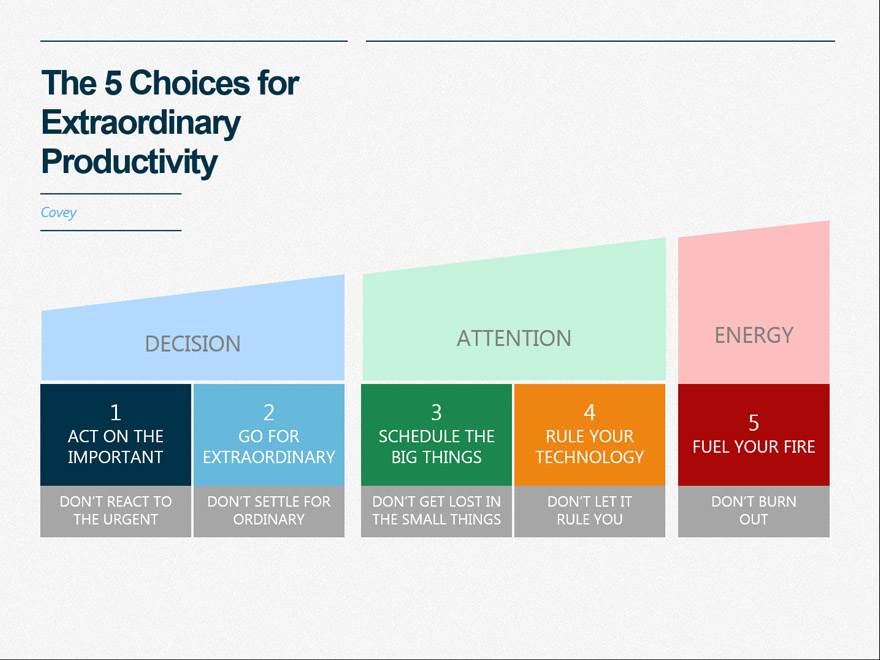
The 5 Choices for Extraordinary Productivity is a framework for achieving more, much more, productivity:
Why
In times when everyone is busy, being productive is key to standing out. Every day many people work for 5-12 hours, however, some get much more done than others. That is productivity at work. The 5 Choices explain how you can (instantly) become more productive. This involves a) making better decisions, b) diverting your attention to where it’s needed, and 3) managing your energy.
5 Choices for Extraordinary Results
- Act on the Important – Do the things that are important, don’t react to what’s urgent
- Go for the Extraordinary – Good is the enemy of great, don’t settle for ordinary
- Schedule the Big Things – Focus on what adds value, don’t get lost in the small things
- Rule Your Technology – Use technology to your advantage, don’t become a slave to dopamine shots
- Fuel Your Fire – Strengthen your vitality, prevent a burn-out
The lessons from the 5 Choices are very clear, be proactive instead of reactive. With this, you can solve the 3 big questions (at work). First, how can you make many decisions, the right ones, every day? Second, how can you divert your attention towards the right places? Third, how can you manage your (limited) energy? That is what the 5 Choices help you to navigate.
1) Act on the Important
Our brain has different sections and they work in different ways. We are automatically reactive, this takes place in our old/reptilian brain. But if we put in some effort we can become pro-active, we can plan and exert self-control (pre-frontal cortex, new brain). Daniel Kahneman also called this, thinking fast and slow. This means you have to ask yourself a simple question: why am I doing X or Y?
The Eisenhower (or Covey) Matrix is the visual translation of this process. If you really ask yourself the ‘why’ question, you should come to the conclusion that the most productive tasks are those which are non-urgent and important. This is the pro-active work, creative thinking or relationship building. Tasks that are also urgent have a 1-on-1 return; if you extinguish a fire you save one house. But if you prevented 10 from burning by installing fire alarms and this took you the same time, the payoff is much bigger. This means we have to say no to urgency and focus on what’s most important.
2) Go for Extraordinary
In your life, you have many different roles. You can be a father, colleague, athlete, child, husband, etc. At many times, you may feel that these roles are conflicting, and they can be. Most important for being extraordinary is knowing what success means for you, in each of the roles. Define your goals and passions in your role description (e.g. Super Dad), and make a role statement. Also, note that roles can (and will) change during your life, they are dynamic.
If you know which roles you have you can make specific goals. You can use frameworks like SMART goals. What it comes down to is; from X to Y in Z time period. This way you will be making non-urgent and important goals that are aligned between your roles.
3) Schedule the Big Things
Your attention is limited and it should be going to the most important things. But as you know your brain loves dopamine, and will therefore gravitate towards urgent things. This is a challenge that you can tackle, it only involves some planning. Take some 10 minutes at the start of your day at the office to make a small planning. Here you can decide when you can work on the non-urgent and important tasks (preferably early in the day). Also, take 30 minutes each week to review your processes and make a global plan for the next week. This whole process takes less than 90 minutes and will make sure your attention is going to the right places. You will be pro-active, every day.
4) Rule Your Technology
There is a new addition on the block, not to alcohol or drugs, but to your technology. People check their phones 85-150 times a day, for many it’s more. And what are you to most likely find on your phone, unimportant tasks. You see the latest in internet cat memes, how a war is going in a faraway place, or what your friends are doing on vacation. There is a near-zero chance that you will find important and non-urgent things on your phone/devices. But what about your email or other places where information is entering your brain?
To combat this trend, you can manage your incoming information in a system. You can decide that you will 1) act on the information, or 2) archive for later use. If you act on information you can make an appointment with yourself when to do it (i.e. in google calendar) or make a task (i.e. in Basecamp). If you archive information you can save it as a contact (i.e. in your phone) or as a note (i.e. in Evernote). And if you really want to get good at it, you can make sure these systems can talk to each other, more on that in Getting Things Done.
5) Fuel Your Fire
Last, but not least, you need to manage your energy. To be extraordinarily productive and take the right decisions you need to be present and awake. To do this you can do five things; 1) move (keep your body active), 2) eat (healthy food), 3) sleep (at least 7 hours), 4) relax (important and non-urgent), and 5) connect (social relationships can boost your energy). If you keep your energy level high you will do your most productive work.
When to Use
This framework is important to keep yourself on track. Without it, you may revert back to being reactive, non-productive and stressed. Therefore I advise you to reflect on this framework when you feel the pressure is building. You won’t always sleep enough, work on those most productive tasks or stay away from your phone, but this framework greatly enhances your ability to do so.
“In the midst of chaos, there is also opportunity” – Sun Tzu
More on the Choices for Extraordinary Productivity:
1. https://www.youtube.com/watch?v=1esyYzebVoA – Youtube video about The 5 Choices
2. http://www.franklincovey.com/productivity/the5choices.php – Official FranklinCovey website
3. https://www.linkedin.com/pulse/5-levels-leadership-framework-floris-wolswijk – My previous blog post about The 5 Levels of Leadership
December 27, 2018
Eat and Run
Eat and Run: My Unlikely Journey to Ultramarathon Greatness by Scott Jurek.
If you want to know how the life of an ultramarathoner is like, this is the book for you. It describes Scott’s life from youth to the last race he is running competitively. Along the way, you meet his best friend, and furious user of profanity, Dusty. You get to know about a tribe of Tarahumara Indians. And you get to know the comradery & loneliness that come for free with each ultramarathon.
Scott holds many records, so I will only list the most impressive one. he set a new American record by running 165.7 miles in 24 hours—6.5 marathons in one day. Yes, that’s right, 6.5 marathons in one full 24 hours (and that isn’t even the longest he has been on the road). It’s difficult to comprehend even how long this is. For us Dutch, it’s 266.7 km, as far as going from Groningen to Venlo.
Two other things make Scott different from most runners. He follows a plant-based diet, i.e. he is a vegan. He finds all his (high quality) proteins in soy, lentils and other non-dead-animal places. And after every race, he gets into a small tent and wakes up each time a new runner arrives to high-five them when they finish. He doesn’t go home or finds a spa, he stays out in the open to say hi to the other runners.
Now after writing his book, there is some fame reserved for Scott. But as far as I know, there was never any fortune (the money kind) involved. He, of course, made some money with sponsorship deals and even is the designer of a popular running shoe. But since running ultra long distances isn’t the best television material, there was never much money. And I think that this also shows that money is something that can be a force for the good, but that it’s necessary for a good life.
December 27, 2018
Born to Run
Born to Run: A Hidden Tribe, Super Athletes, and the Greatest Race the World Has Never Seen by Christopher
What if an investigative journalist decides to tackle a personal problem? What if this problem is this: my foot hurts, how can I make it stop? This is the simple questions that set Christopher on a journey that finds him on the path with Scott Jurek (see Eat and Run), the Tarahumara Indians of Mexico and some other amazing people. Along the way, we dive into the science and non-science of running.
The most surprising thing about this book are the revelations about running(shoes) that I was taking for granted. A shoe that has more cushioning and helps correct your foot should help you prevent injury… right? It turns out that the rate of injury has not gone down a single digit since the invention of the modern running shoe (1970). Isn’t that odd? Christopher thought the same and found out that a soft shoe also makes for soft feet, and that a bigger cushion translated into us putting down our feet more thoroughly to compensate for the lost sense of feeling the ground.
What it also shows is that a very average (but not unhealthy) man, 40 years of age, can train to run a 50-mile race through very unforgiving terrain. The last chapters of the book describe a fascinating race between Scott, the Tarahumara’s best runners, a dozen of the other bests in the world, and Christopher. He takes twice as long as the fastest person (guess who) to finish, but does it. It’s an amazing accomplishment and is only overshadowed by how this book gives a beautiful insight into running and it’s crazy culture.
See below for a video of Christopher talking about running, the evolutionary story and some more about our running shoes.
December 27, 2018
Carbohydrates 101
Now that my runs are becoming longer and longer. I started wondering what I needed to do with regards to nutrition. That is where carbohydrates (carbs) started to pop up. Of course, I know what carbs are, but what do they mean when related to going on long runs. In this post, I will explore our carbohydrates stores, what to eat/drink during runs, and what to eat beforehand.
Carbohydrates 101
Carbohydrates are the primary source of energy for the body. There are fast and slow types of carbohydrates, depending on the speed which they are absorbed by the body. Some sources of carbs are oats flour, soy, and rice. In Queal about half the energy comes from carbs, both fast and slow.
Fast and Slow
The distinction between fast and slow carbs is something that I only heard of, but never looked into before. Luckily I did already know about the Glycemic Index (GI), this states how fast carbs are processed in the body. Carbohydrates are all chains of simple sugars. Your body breaks these chains down to individual sugars to process them. The more complex these chains, the lower the GI and the ‘better’ the carbs are.
A simple rule of thumb is that when a nutrient is high in fibre and nutrients it’s a slow carb, when processed and low in fibre and nutrients a fast carb. Glucose (sugar) has a GI of 100. Everything that is below 55 is slow, below 69 is medium and above 70 is high. Examples of slow carbs are steel cut oatmeal (in Queal), whole wheat, most fruits, nuts, seeds, beef, chicken, eggs. Examples of fast carbs are white bread, instant oatmeal, pretzels, popcorn, cornflakes and white rice.
Storing Carbs
So what types of carbs do you need as a runner? Both. In the days before your run, you will make sure that your body has enough slow carbs that it can store. And during the last 18 hours before your run, you will stack up on fast carbs that will also release when you need them. During a marathon, it’s also advised to drink/eat only fast carbs, so that they may be released immediately.
In your body, you can store about 400g of glycogen in your muscles and about 100g in your liver. In total, this equals about 2000 kcal in energy. For me, this is about 21km (or halfway there) worth of energy. If you run out of glycogen your body will resort to using fat as an energy source and in only very extreme circumstances protein. The problem with this is that fats are about 15% less effective (more difficult to convert to usable energy) and therefore you will slow down.
With training for a marathon, you want to do two things. The first is to increase your store of glycogen. This can through training. If you are more fit you will be able to store more glycogen. In the days before the race, you should then of course also eat a lot of slow carbs to fill this space. Depleting your body of glycogen (e.g. going into ketosis) about 7-4 days before the race hasn’t shown to be beneficial to your glycogen storage capacity. The second is to become used to running on fat. This means that you can do a slow, but moderately long distance, run on an empty stomach. This way your body is already a bit familiar with running on fat.
During the Run
The big race day is there. You’ve eaten a lot of carbs and now you want to make the most out of the race. But what if you want to extend the carbs some more, could you eat during running? That is what I tested today, and yes it’s very much possible. I ate a bite of a bar at every 5km and although I felt my liver a bit, it was great for my energy levels. Eating during a run has two benefits, one being more energy, the other of replenishing your electrolytes.
Electrolytes? Yes, I also didn’t really know what this meant. It a name for all the minerals in your blood (and other bodily fluids) that carry a charge. You lose electrolytes when you sweat. Common types of electrolytes are sodium, potassium, calcium and magnesium. The common sports-water drinks contain all the necessary electrolytes and also have some carbs in there. If you drink these you may prevent these things that are related to imbalances in your electrolytes: muscle cramps, stomach cramps, side stitches and fatigue(1).
During the run, you can also eat solid foods and gels. Your body will be able to take in about 100 kcal every 45 minutes, try and eat about this much and nothing more. You can think of cliff bars, energy bars and even things like dates. Another option is gels, they have the perfect amount of carbs per bag (100 kcal) and I will try some in the next week.
December 27, 2018
The Hierarchy of Engagement
In this article by Greylock Partners (Venture Capital firm) Sarah Tavel explains how engagement is built.
These are the four steps/levels
- Growing engaged users – completing the core action
- Retaining the users – product gets better with use, users should lose something when stopped
- Self-perpetuating – users create virtuous (growth) loops
- €1B+ company – all 3 above plus some magic
Tavel states that user engagement is the driving force behind a product/company.
And knowing what to do as a company start as art (early stage) and become a science (later stage).
Her model ties in with the Hook model (trigger, action, reward, investment, tri…)
(also mentioned in The Power of Habit)
Step 1
In the beginning (first step) the growth of users isn’t the most important statistic, it’s users completing the core action.
For this to happen, users need 1) motivation, and 2) ability.
At Queal I can ask myself, what is the core action that our users need to do?
- Is this a shake every week? And if yes, how do we measure this precisely? (or do we do this with random samples/emails)
Step 2
Will users stick? This will determine the long-term success.
For investors it’s important to look at the accruing (compounding) benefits as the user engages, and mounting losses if they leave the product (e.g. you can’t see your friends posts on Instagram anymore).
Insight: This is why anonymity apps don’t work, they don’t provide new benefits after you start using the product. You don’t build your identity based on such an app (which I guess is kinda their point too).
- How long do users stay engaged with Queal?
Step 3
The engagement of existing users creates virtuous loops, it makes the product even better. This is what happens if people post things on social platforms. But this doesn’t happen if someone finds his/her true love on Tinder.
- Is there a virtuous loop possible for Queal (as an offline product?)
How do you build engagement? And in what phase are you yourself?