• Sort Blog:
  • All
  • Book Reviews
  • EA Rotterdam
  • Essays
  • Flotes
  • Goals
  • Links
  • Series
  • Short Stories
  • Uncategorized

Hell Week

The below is a compilation of several posts I did back in December 2015 when I did the Hell Week by Erik Bertrand Larssen.

Today I’ve started the ‘Hell Week’. This week is based on the hell week of navy seals, adopted for civilians. Getting up at 5 AM, challenging yourself and working your butt off is all part of it.

During this week, every day has a different theme. Today (Monday) is all about habits. The good, the bad, and the ugly.

Below I’ve made a list of habits I think are good, could be better, are bad and ones I want to adopt this week (so actually more goals I want to work on daily).

Monday: Habits

Good

  • Morning exercise routine – every morning I do a 5-minute routine to strengthen my core and prevent back pain
  • Morning weigh-in – losing weight means tracking it
  • Focussed work/flow – during work I’m in the flow a lot of times
  • Daily reading (even better) – I read at least for an hour every day, this week I want to see if I can read (+listen) to one book a day
  • Exercising – I normally go to the gym 3 times a week, running will be added from this week onward

Better:

  • Tracking food intake – especially at the end of a week I ‘forget’ to track my food intake, not happening this week
  • Morning planning – without planning, how do you know if you are working on the most important things? (and it only takes 5 minutes)
  • Evening reflection & planning – reflecting on the day can also be powerful and I will do it every day
  • Weekly goals (all Q2 activities) – I’ve made a goal for this week and have one priority per day
  • Tasks lists work and home – GTD system – I’m good at saving things notes, but I can use a better way of organizing them after that

Bad:

  • binge eating – this, of course, defeats the whole purpose of exercising and restricting calories
  • binge drinking – see above and terrible headaches and days without productivity
  • crash&burn: get out more on relaxing days (e.g. Saturday and Sunday) – I will relax more on the weekend and get outdoors more

To change my habits I know of three very accessible techniques:

  1. The first is knowing about your habits, putting them in writing and reflecting on them is a good start. You can also ask other people around you if they notice any (good or bad) habits you have.
  2. The second is making implementation intentions. This means that I will know what to do when someone offers me candy or booze (say no thanks). It’s about making if X then Y. Therefore, I’ve gone through a lot of scenarios around my habits and thought about what to do when things aren’t going naturally.
  3. The third technique is the coupling of new and old (good) habits. After my morning routine, I immediately work on my planning for the day. And every evening when I do my agenda and reflection I will also sort out my notes for the day.

New:

  • Overview of finances – automate the system of tracking where I spend my money
  • Sale of furniture that’s not going to move with me – I’m moving somewhere in the near future, so I will off my old furniture
  • First plans for new furniture/style – and I’ll think about the things I want in my new house
  • Clothing habit/rules/organize – what if you don’t have to think about what to wear each morning?
  • EA community NL – I want to do more with effective altruism, I will take steps this week

Hell Week rules

Here is the list of rules from the book. Added to it are some of my own rules/exceptions.

  • Get up at 5 am; go to bed at 10 pm
  • Work out daily for an hour, preferably in the morning
    • Be active for more than 2 hours (Google Fit tracking)
  • Eat healthily
    • Cycle calories for maximum deficit effect
    • Vegetarian
  • Work hard, be focused
    • Focus on Q2 tasks and do reactive things only after 12 am
  • Be the best and happiest you can be at anything you do
  • No tv
    • Don’t have one, will do 1 hour of series for relaxing
  • No social media during work; no private matters during work; no small talk during work
  • No sleep between Thursday and Friday

Wish me luck!

Waking up at 5 AM has its benefits, you have more time in the morning to do meaningful things. It also has a downside, feeling dead tired in the middle of the afternoon. I actually fell asleep for a few minutes whilst relaxing with a YouTube video. But after moving some I got back my energy. With some luck, I will get to bed at 10 PM and will get the 7 hours of sleep I need/deserve.

During this week, every day has a different theme. Today (Tuesday) is all about mode & focus, or as I will call it: roles. It’s about who you play during the day (friend/colleague/sportsman/etc) and how you behave in these roles. It’s also about how you feel in a role and if you can really focus on being that specific person.

Below is an overview of the most common roles I see myself in. I organized them by the roles I’ve been in today and how I see myself behaving in the role on average.

Tuesday: Mode & Focus

Today I’ve been a 1) student, 2) thinker, 3) sportsman, 4) entrepreneur, 5) colleague, and 6) friend. During the day, I’ve tried to be one role at a time. I think this is the best way of going about things, to have a complete focus on your role. I did, however, notice that when at work it’s difficult to be a friend (two friends dropped by) in the work setting. I could have done a better job at letting my work go for the moment.

  1. Student: I like to learn new things, gain knowledge and know a lot about the world. The main place I take in this information is whilst reading in the morning. Another time is when I’m biking or when in the gym (where I think it’s ok to combine two roles). I think I can be the best student by learning consistently every day, for at least 1 hour.
  2. Thinker: I would say this encompasses my personal ‘non-urgent x important’ tasks. This includes making daily planning, meditating in the morning and learning about philosophy. I think I can be the best thinker by training my mind every day and learn something new about philosophy every 3 months.
  3. Sportsman: This week I will exercise every day, after this week it will be about 5 times a week. Next, to a well-sculpted mind, I would also like my body to reflect the same strength. Because there is a marathon coming up in a few months I will focus on running, but I will also keep my strength by visiting the gym. Also, to defend this role I will focus more on cutting excesses from my life (e.g. eating or drinking too much).
  4. Entrepreneur: This encompasses all my business related work. One thing I’ve noticed the last year is that working during the weekend is detrimental for the next week. Therefore, I think it’s best to focus on working smart during the week and keep work to a minimum during the weekend. Also, I use my knowledge from my student role very much during my entrepreneur role.
  5. Colleague: Next to being an entrepreneur I think it’s also good to have productive (and fun) interactions with my colleagues. The reasons I made these two roles separately is because I think it’s better to do research, website stuff, etc on my own and discuss things at set moments. And I think being a colleague is more about helping and interacting than getting the most done.
  6. Friend: What is the world without friends. What I think I could do best here is be more in the moment. My brain is all over the place at some times and I believe that having more focus can help me be a better friend.

That’s all for today. Now it’s time for an early bed and a good run tomorrow morning.

The problem with sleeping less is that the extra hours you have won’t increase your productivity. I do want to stick to the 5 AM waking time, just to complete the challenge, but I know already that sleeping enough is the best way to go.

That being said, it’s the morning of day 4 and tonight I won’t catch any sleep (the challenge is to work day and night). I’m going to make the challenge even more difficult by not drinking any stimulants (cola/coffee/etc). I will also get all the ‘small’ things I want to do done.

But that’s today, what about yesterday? Wednesday’s theme was about planning. It involved making a to-do list, week planning, month planning, and year planning. Or in other words, planning the big rocks first before you add the sand.

Wednesday: Planning

Here I have to be honest, I only got two of the things that I wanted to do done. I made a to-do list and finished quite some of the tasks I had on there. I also have a week planning and know what I want to achieve each day. What I didn’t do was make the long term planning. After work, I didn’t have the mental energy to sit down and think about my long term goals. After configuring my new computer (one of the things from my to-do list) I played 2 hours of Fallout 4.

It’s sometimes difficult, or actually often, to do the things you know you need to do. For this, I think something like a hell week is a good prompt to get started. But as you may have noticed, it isn’t foolproof. What I could have done better is to take a short moment to do some meditation, get stuff done and hop over to bed. Now I don’t say that my day was wasted, I can be proud of the other things I have accomplished (sports, progress at work, Coursera course, etc). In the end, it’s about becoming a better person and although I didn’t do everything I wanted to do, it was a good day.

Now I’m off to two long days of working hard, sleeping little and learning how to recharge when you haven’t slept.

Fingers crossed.

I survived. In the past 38 hours, I’ve snoozed away 2 times for a max of 30 minutes. I’ve been to the gym twice. I (re)installed my computer, installed a Raspberry Pi media centre, organized my books, and generally survived surprisingly fine.

Thursday: Outside the Comfort Zone

Yesterday (although this feels like one day) started as the other days. Up at 5, meditation, planning, gym, work, etc. I took some time to make preliminary planning for next year and generally worked my butt off (I’ve been told I’m not too nice of a person to my computer, so let’s hope the computer won’t take over soon). The test came when it started becoming evening.

Because of the relatively late bedtimes of the past days, I was already feeling a bit tired. The first nightly hours were spent at the Venture Cafe (feel free to join each Thursday @ Groothandelgebouw 4th floor, 15-20.00 hours) and Suicide Club. No alcohol was involved.

When I got home I did stock up with some Cola, just in case. I went to work on organizing my series, installing programs and games, and making my computer awesome overall. Around 3 AM I folded and started drinking the kool-aid (cola in this case). This keeps me awake whilst doing the more boring parts (e.g. renaming folders/files).

Friday: Recovery

In the morning I made a lovely breakfast (4 eggs, feta, pesto, olives, spinach). What I didn’t anticipate was a slight after-dinner dip and subsequent sleepiness whilst sitting completely still and trying to meditate. Lesson learnt, keep doing things when sleep deprived. After a very short nap, it was time for a ‘normal’ day again.

At work, I felt I was a bit more grumpy, but overall feeling not that much different. In the gym, I was still able to do 30 minutes of cardio and even found swimming more relaxing than normal. Overall I can say that a day of relative rest is a good way to spend your day.

To conclude this part: sleep deprivation is bad for you, but you can deal with it surprisingly well.

Hellweek was fun. I’m not saying that (only) to trick you into doing one yourself. No, I think that challenging yourself can be a rewarding exercise and it’s definitively been that. Has it changed my life? Yes, in some regards I have changed, but it wasn’t as revolutionary as Erik Bertrand Larssen wants you to believe.

Saturday: Inner Dialogue

What are you good at? This day is about thinking positively. For me, that meant being positive and also being less critical on myself. I went on a bike ride around the Rottemeren and listened to ‘How Google Works‘ and really enjoyed the weather. Yes, I did do some work, and I liked it. It wasn’t forced and coincidently Onno was also there. In the afternoon, I went to Utrecht to visit a museum with my mother. I guess I’m not that bad at being positive.

Sunday: Put Your Life in Perspective

Today I slept in a bit because in the afternoon I did the Bruggenloop. I did some work in the morning and joined the crowd of athletic people. Putting your life in perspective is quite abstract and I did it my way. I can conclude that I’m very happy and that I love doing most of the things I do. The other things I see as learning experiences. I also loved the run and finished in 1.26 hours. Now onto the preparation for the marathon.

A week with Larssen was challenging. The first few days are the toughest and the others make you think more than usual. I can really recommend it to anyone who dares to take on the challenge.

Sophie’s World

What a book! Written for children (of all ages) and a great way to learn more about philosophy.

Together with Sophie, you take a journey through history. You learn from the Greeks, from Kierkegaard, and most of all from the conversations between Sophie and her mysterious philosophy teacher.

What makes the story great (for me) is the interaction between Sophie and Alberto Knox (her philosophy teacher). She acts as the reader and asks questions you might also have.

The book is a bit heavy on information for an audiobook (the way I ‘read’ it). But if you already know some philosophy, it can be a great listen.

There is even a mystery weaven into the fabric of the book that will result in a very nice and unexpected ending.

See a full summary here on Wikipedia and a timeline here.

The Messy Middle

The Messy Middle by Scott Belsky came to my attention via the Tim Ferriss Show. I really enjoyed their conversation and Scott’s outlook on how to do the work required for a start-up in the years following the blissful start.

Alas I found the book to be not in the format I could enjoy it in. It’s divided into small chapters that all contain nuggets of information (not unlike ReWork). But somehow I couldn’t really identify with what was being said, or I thought in many cases “duh, I know that”.

So I’ve put the book down and who knows I will read it again another day.

The Black Cloud

The Black Cloud by Fred Hoyle was a good sci-fi book that explores both human politics and another way a consciousness can be. One thing I was most suprised by were the strong characters and how the interaction between the human ‘factions’ played out.

Let me go back to how I reviewed some earlier works of fiction and analyse the story steps, spoilers ahead:

  1. You: the whole human race, or more specifically the researchers who we get to meet
  2. Need: need to be understood, they made a discovery
  3. Go: travel around the world to connect the dots
  4. Search: what is the cloud? can we understand it?
  5. Find: the cloud arrives
  6. Take: and billions of people die
  7. Return: they can talk to the cloud and eventually it leaves
  8. Change: there isn’t more than a page at the end of the book (after the events) so I think there wasn’t much here and that could have been further explored

Happiness

Happiness is what makes life worthwhile. It supersedes other goals, like money, friendship, and love. In the end, we all want to be happy. So striking, and unnerving is that there is no direct route to happiness. When people try to buy it by becoming rich, they will want to become even richer, they stop enjoying the little things, and their happiness will not increase. I, therefore, find the quote by Mihaly Csikszentmihalyi (author of Flow) so great. By living in the now, you will be happy, no matter the circumstances.

The centrality of happiness is very well illustrated by the number of quotes on the topic. This paragraph features some of the greatest thinkers of all time and their views on happiness. 

“Men can only be happy when they do not assume that the object of life is happiness.” – George Orwell. 

“Remember, happiness doesn’t depend upon who you are or what you have, it depends solely upon what you think.” – Dale Carnegie. 

“Pleasure is the only thing to live for. Nothing ages like happiness.” – Oscar Wilde. 

“Happiness is like those palaces in fairy tales whose gates are guarded by dragons: we must fight in order to conquer it.” – Alexandre Dumas. 

“If you want to understand the meaning of happiness, you must see it as a reward and not as a goal.” – Antoine de Saint-Exupéry. 

“…happiness is the highest good, being a realization and perfect practice of virtue, which some can attain, while others have little or none of it…” – Aristotle.

Profile of Warren Buffett

It takes 20 years to build a reputation and five minutes to ruin it. If you think about that, you’ll do things differently.
Warren Buffett

There is rich, and there is Warren Buffett. Do I mean that he is more wealthy in terms of money than everyone but a handful of people on this earth? Yes! At the same time, I am referring to his life philosophy. Warren Buffett lives a simple life. He does not live in a large mansion, nor does he have a 10 man strong security detail. He spends his days reading and learning, ever advancing his knowledge. There are many leaders who have built great companies, Warren Buffett built a great conglomerate.

The first rule is not to lose. The second rule is not to forget the first rule.
Warren Buffett

As noted in an earlier article true entrepreneurs are risk-averse instead of risk-takers. Warren Buffett, on the one hand, finds opportunities where others do not see the advantage of doing business, yet also tries to leverage his buys so that he is never in a position to lose. By having his things in order he is prepared for the worst, so when things get tough he will stand strong. Next to being risk-averse he also likes to keep things simple, Warren Buffett believes in not complicating things when not needed and has a strong ability to see through complicated matters and to spot the silver lining.

Honesty is a very expensive gift – do not expect it from cheap people.
Warren Buffett

Trust is another one of the great characteristics that Warren Buffett possesses. By strategically giving trust to people around him he has created a company in which there are low interpersonal costs and people can build on each other. Warren Buffett has been in a partnership with Charlie Munger for almost the whole of his life, he has trusted him in everything and therefore discussion will be constructive instead of destructive. Trust is not only an interpersonal skill for the good, it also has saved him many millions on due-diligence and other non-trust measures that did not have to be executed.

I have always wanted to improve what I do, even if it reduces my income in any given year. And I always set aside time so I can play my own self-amusement and improvement game.
Charlie Munger

The last lesson learned here from Warren Buffett and his business partner Charlie Munger is to be a learner your whole life. Investing in your education, reading every day, is what they find to be one of the key habits of smart people. This means cutting down on your time spent with ‘news’ and social media, but to set aside a minimum of 1 hour a day to read, to understand, to discuss and build your cumulative knowledge.

By trusting the people around you, getting the right people on the bus (a risk-averse one that is), and building your knowledge base – you will reach an ever-growing body of success!

References & Further Reading:

1. http://www.farnamstreetblog.com/2013/05/the-buffett-formula-how-to-get-smarter/

2. http://www.forbes.com/sites/erikaandersen/2013/12/02/23-quotes-from-warren-buffett-on-life-and-generosity/

3. http://www.forbes.com/profile/warren-buffett/

4. http://www.berkshirehathaway.com/

Absolute Moral Rules

Currently, I am taking a Coursera (online university courses) on Practical Ethics. Next to lectures and readings the course also consists of writing assignments, this is the first one. In this short essay, I am defending absolute moral rules. Disclaimer: I have yet to figure out for myself the position I want to take concerning morality/moral rules, but this one comes pretty close.

Do any moral rules hold without exception, no matter what the circumstances?

Moral rules are concerned with the principles of right and wrong behaviour. They define in a broad sense what behaviour is looked up to, and what behaviour people condemn. According to James Rachels, a person, a moral actor, is perceived to, at the very least, to guide one’s conduct by reason while giving equal weight to the interests of the people affected by the decision. David Hume states that reason is the consequence of our passions, our behaviour follows from them and thus also morality. Emmanuel Kant opposes this position and states that we can have a universal moral law. In this short essay, I will defend this last position by defining, examining and defending a universal moral rule.

Doing justice is one of the 13 moral rules that have guided one of history’s greatest men; Benjamin Franklin. In doing justice he means that you wrong none, by doing injuries or omitting the benefits that are your duty. With this, he means that a person is not to bodily harm another person, and thus doing injustice to the other and yourself. Also when you have benefits that are your duty to give to others, it is morally wrong to omit it from them. Doing justice here is an absolute moral rule, it is a principle that ought never to be violated.

There are two main objections to the use of absolute moral rules. The first is concerned with the use of the rules; is it applicable to everyone?. The second is concerned with the consequences of the rule; what about the consequences? I will defend the use of absolute moral rules using the example of doing justice.

It is true that not everyone does justice, and even the people who do justice, do not do this all the time. In different cultures, people have defined specific cases of justice on different terms. Even over time, the notion of justice has had changes. These changes, however, are subtle and are concerned with specific cases and not the idea behind doing justice. Take for instance the benefits of your labour, to whom do you distribute them? If a person decides to give everything away to charity this can be conceived to be a morally just decision. At the same time, a person who only spends his money on his own family is not doing something wrong morally. But when a CEO receives a large bonus whilst his company is losing money, everyone can agree that this is morally wrong.

What if everyone does justice? This opposition is concerned with the consequences of the moral rule (which in itself is deontological). Imagine that you are in a room with a terrorist and the only way to get to know where a nuclear bomb is hidden is via physical torture (i.e. doing injustice to the terrorist). The moral rule can still apply here, based both on deontological and consequentialist reasons. Concerning the former, it can be stated that doing any bodily harm to anyone is wrong in that it violates the rights a person has, terrorist or not. Holding onto a moral rule can, therefore, be seen as more important than the catastrophic outcomes of a particular (hypothetical) situation. Concerning the latter, you do not know if the terrorist will give the right information. Taking both positions together, doing injustice is a means that is not defendable by its ends.

Some moral rules hold without exception. Doing justice is one of the moral rules that endures criticism and is universally applicable. It is true that not all proposed moral rules hold without exception. Some examples of questionable moral rules are; have patience, be loyal. Other moral rules are very much debatable as to whether they hold without exception (e.g. do not gossip, be forgiving). Next to doing justice other moral rules also make intuitive sense and equally successfully can stand opposition; respect others, be dependable, humility.

Having all moral rules be dependent on the consequences of a situation is the opposite view of the one being defended in this essay. This is essence is a consequentialist argument. There are two problems with this kind of an argument. The first is the extent to which you define consequences, for who, when, where, etc.. The second is the practical application of consequentialist thinking, it is not practically possible for a person to, for each decision, to determine and weigh the effect of his actions. Therefore using a consequentialist approach to moral rules is both impracticable and unclear in its definition of what is right and wrong.

Doing justice is a moral rule that holds without exception, no matter the circumstances. This moral rule, and others, can help us understand better and let us live a moral life.

Control Framework

Have you ever struggled with something that did not want to go to where you were aiming for? Or some you felt that you were constantly reacting to external things and had no time for your own plans? Everyone probably has. There are two small frameworks that can help you identify when this is happening – and get going again. One step at a time.

As humans, we have the unique ability to act, to think about what we will do between stimulus and response. If you are happy and accidentally bump into your neighbour, “sorry” will be the most likely response. But when you are having a bad day, “ugh” would be more likely. The first framework is best explained by Stephen R. Covey:

“Between stimulus and response there is a space. In that space lies our freedom and power to choose our response. In those choices lie our growth and our happiness.”

If we are aware of the freedom to choose our response, the second step is to identify when to do what:

  1. Direct control
  2. Indirect control (influence)
  3. No control (concern)

Direct control has to do with the response we ourself can give. Here we can directly choose to react differently. By changing your behaviour you will actually be able to influence your attitude (try sitting upright for 10 minutes – do you feel the confidence?). Of course, you are not always able (or willing) to change your behaviour, but it is always a possibility.

Indirect control is about the responses of the people around you, people with whom you have a personal connection. If you keep positively affirming a friend, their belief in their own capacity will grow. The influence, however, is indirect, you cannot look inside the head of your friends and your influence, therefore, is limited.

No control lies in situations where, whatever you do, the situation will not change. Screaming at the presenter on television or extensively worrying about things happening on the news will not change anything. It is these kinds of situation that you should divert the least amount of energy to. And yes, it can sometimes be a relief to scream at the television, but it will not lead to change.

Circle of Concern, Circle of Control

Think for yourself on what level your behaviour falls, are you focussing on your direct circle of control or more on no control situation. Sometimes by doing less, you can do more. When keep barking up the wrong tree, your energy will be wasted. If you work with your direct and indirect circle of influence – your energy will grow. You will become proactive – one step at a time.

Photo Credit sqauwkpointalljapaneseallthetime

The 5 Levels of Leadership

The 5 Levels of Leadership by John C. Maxwell describes a leadership framework which I’ve explored in two posts before. Here they are combined.

This post is based on the leadership guru/expert John Maxwell and his talk about The 5 Levels of Leadership. Go watch it here https://www.youtube.com/watch?v=aPwXeg8ThWI

“Leadership is influence” – John Maxwell

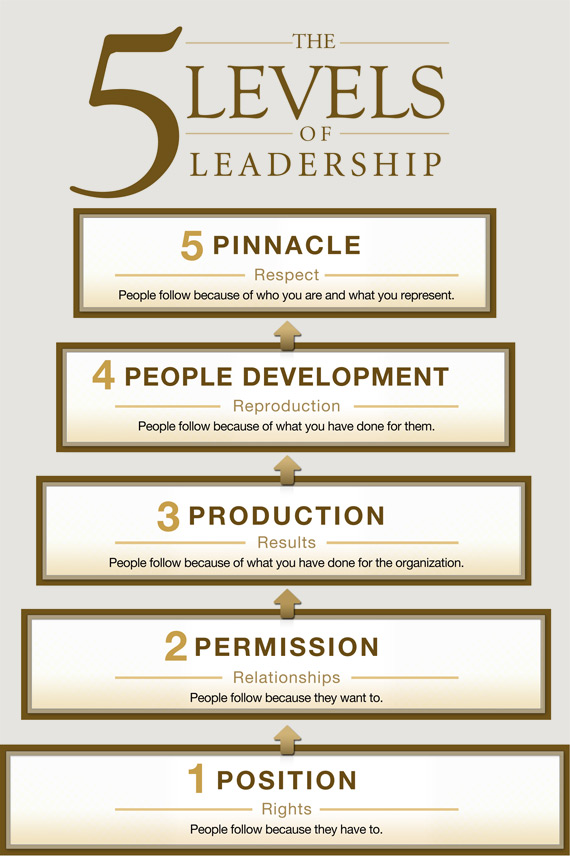
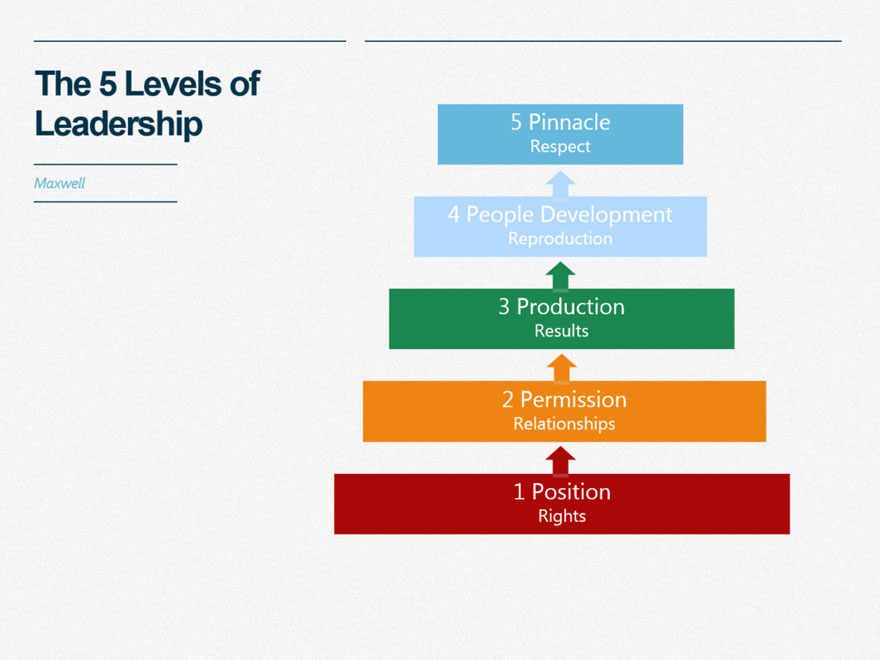
According to John Maxwell leadership consists of 5 levels. Each level builds on the last one, and the higher the level, the better a leader you are! Let us get right into it:

5. Pinnacle Leadership – Respect: people follow you because they respect you!

People follow you because who you are, because of what you have achieved. This level is only achieved by a small number of people.

Upside: Your reputation allows your message to spread further.

Downside: Nope, not here!

Telltale signs. People respect you

4. People Development Leadership – Reproduction: people follow you because you are developing them!

You train people, you shown them how it is done and how they can show others.

Upside: You transfer your skills to others and start growing your company.

Downside: If there is any – it is that the development is not going automatically yet.

Telltale signs. People are learning, developing, growing.

3. Productive Leadership – Results: people follow you because you give the right example!

You are the example for the rest of the employees. You start gaining credibility because you show you know what to do. “We attract who we are, not who we want”. You create momentum, people get going because of you and keep on going when faced with hurdles.

Upside: You produce, you are an effective leader. Level 3 leadership takes care of 80% of the problems in your organisation.

Downside: You are teaching no one about leadership.

Telltale signs: Things get done, problems get solved.

2. Relationship Leadership – Permission: people follow you because they want to!

You 1) listen well, 2) observe, and 3) learn. You have an attitude of servanthood.

Upside: People like you for being their leader. It is the foundation of leadership.

Downside: Next to being likeable, not much is happening.

Telltale signs: People like you for who you are as the attentive leader

1. Positional Leadership – Rights: people follow you because they have to!

]Upside: You start on your leadership journey, you will learn how to become a true leader.

Downside: The people who follow you will give you the least amount of energy, time and attention.

Telltale signs: People start cleaning their desk at 4:30, start saying goodbye at 4:45, and leave at 5:00 PM, not a minute later.

So on what level am I?

You are not on the same level with everyone. With some people you are on level 1, with others you are on level 3.

The take-home message is: start developing these relationships to grow to the next level.

More Momentum

Momentum can be the driving force behind your leadership. Why, you ask?… Here is an example:

Momentum: Imagine you are riding a train going at 80KM an hour. In the distance is a concrete wall, 20cm thick. Your train continues at 80KM an hour and hits the wall. And without slowing down you keep on going, your momentum has blasted you through the wall.

No Momentum: Imagine you are riding a train, a train that still has to leave the station. In front of you is a concrete wall, 1cm thick. Your train wants to start moving, want to leave. But all that happens is that you are stuck behind the 1cm concrete wall.

More on Development of People

1. Recruitment – The better people you bring in the door, the better chance of success you have. 80% of success of your people is at the front door.

2. Positioning – Get people in the right seat (on the bus). Let them work the sweat spot. They work their strengths. Successful leaders position others well.

John Maxwell explains that in his high school football team the first team was invited to play the second team. The only rule was that they could not play their position. The offense became defense and viceversa. And now you can probably guess who won.

3. Equip – First learn it yourself, then do it together (be a mentor), then let the other person do it (observe, tweak, improve), then let them do it alone, and then – let them explain it to others!

References & Further Reading:

1. https://www.youtube.com/watch?v=aPwXeg8ThWI thanks to Rens Dimmendaal for recommending the video!

2. http://www.iequip.org/

##

“A leader is one who knows the way, goes the way, and shows the way.” – John Maxwell

The 5 Levels of Leadership is a framework for leadership in almost any situation;

Why

The first day on the job as a leader doesn’t make you a leader. It may say so on your business card, but people won’t follow you through the gates of hell, heck they may even start packing their bags at 4.45 PM. The 5 Levels of Leadership explain how you can become a better leader and in effect make better leaders out of the people who follow you. It’s a lifelong journey, one that I most highly recommend you take.

5 Levels of Leadership

  1. Positional Leadership – Rights: people follow you because they have to!
  2. Relationship Leadership – Permission: people follow you because they want to!
  3. Productive Leadership – Results: people follow you because you give the right example!
  4. People Development Leadership – Reproduction: people follow you because you are developing them!
  5. Pinnacle Leadership – Respect: people follow you because they respect you!

Now lets see how the levels of leadership can apply to you as a brand-new leader of a group of about 12 people during a week long event.

1) Positional Leadership

You’re assigned leader of a group. Congratulations, this is the first step to becoming a leader. During the opening ceremony you’ve met the members of your group and they are being told that they have to follow you. But what if they discover that no-one will check if they switch groups, what keeps them from leaving your group? Actually nothing, without a relationship between you and the people you lead, they will only follow you until a new opportunity arises.

2) Relationship Leadership

The second level of leadership is relationship building. This can be done by 1) listening well, 2) observing your group, and 3) learning on the go. This level has also been called servant leadership, you serve the group and build connections. People will follow you because they want to. Your group now has become fun, maybe cozy (or as we Dutch like to call it ‘gezellig’), but you are not yet productive.

3) Productive Leadership

To become productive you have to give the right example. If you start by disregarding the program, showing up late in the morning or drinking excessively, your group will get nowhere. Leadership expert John Maxwell said “We attract who we are, not who we want”, I think this applies not only to people, but also to their behaviour. If there are challenges, group assignments or other things that require teamwork, a level 3 leader (and his or her team) will be the ones to win it.

4) People Development Leadership

A week is very short time to develop people. It’s too short to show people how to do the work/study/etc. But it’s long enough to help them become good social people. If you take an effort in learning their names, explain to them the benefits of remembering the names of others. If you are respectful about differences, show them how they can copy that behaviour. At this level people follow you because you are developing them.

5) Pinnacle Leadership

The final level of leadership is something that is developed over a long time. This is a level that can be obtained by developing people, being productive and having great relationships over a long period of time. The organizer of the week long event may be very well the only one who reaches this level. At this level your track record speaks for itself and people follow you because they respect you.

When to Use

Use this framework right now! Think about what level leader you are right now. Is this different at home than at work? And how can you advance your level, what do you need to improve on to become a better leader? Good luck!

“Leaders must be close enough to relate to others, but far enough ahead to motivate them.”  – John Maxwell

Vagabonding

Vagabonding by Rolf Potts

Summary: Book with tips and tricks about long term travel.

One incredible trip, especially a long-term trip, can change your life forever. Everything in Vagabonding works, if you work on yourself. – based on principles

Not as an escape but as an adventure and a passion

Gain impressive wealth (time) through simplicity

(index: earn your freedom, keep it simple, learn and keep learning, don’t set limits, meet your neighbours, get into adventure, keep it real, be creative, let your spirit grow)

How to Win Friends and Influence People – Dale Carnegie – common sense – good advice

Research your own experiences for the truth Absorb what is useful Add what is specifically your own The creating individual is more than any style or system

Travel is for many busy overachievers a way to seek a simpler life (but won’t find it) No combination of one-week or ten-day vacations will truly take you away from the life you lead at home. The more we associate experience with cash value, the more we think that money is what we need to live. Long-term travel is about being a student of life It requires only that we walk through the world in a more deliberate way Use the prosperity and possibility of the information age to increase your personal options Look for adventure in normal life, and normal life within adventure

Vagabonding is an unusual way of looking at life Vagabonding is about time and how we choose to use it

Many people use the future as a way to justify the present They use the best part of their life to earn for later, then spend it when it matters the least Vagabonding is about gaining the courage to loosen your grip on the so-called certainties of this world.

It’s a process by which you first test the waters that will pull you to wonderful new places It’s not for the comfort hounds, sophomoric misanthropes or poolside faint-hearts, whose thin convictions won’t stand up to the problems that come along.

Earning your freedom, of course, involves work, and work is intrinsic to vagabonding for psychic reasons as much as financial ones. – chance to find yourself As a vagabond, you begin to face your fears now and then instead of continuously sidestepping them in the name of convenience

Walking to work was an exercise in possibility

Even if your antisabbatical job isn’t your life’s calling, approach your work with a spirit of faith, mindfulness, and thrift.

Create your own free time. Use constructive quitting (negotiate free time)

List the job skills travel has brought you: independence, flexibility, negotiation, planning, boldness, self-sufficiency, improvisation.

Quitting means not giving up, but moving on; changing direction not because something doesn’t agree with you, but because you don’t agree with something.

www.riskology.co www.guru.com

Travelling around the world is statistically no more dangerous than travelling across your hometown.

Conditions are never perfect (so just do it)

Keep it Simple.

Material investments are less important than personal investments – but this believe (flip) is why many people never go travel simplicity – a conscious decision how to use what income you have adjust your habits and routines within consumer society itself

time is what you need to live

simplifying your life may require a somewhat difficult withdrawal period. – stopping expansion – reining in your routine – reducing clutter – live more humbly – rent our your house – people may respond with enthusiasm or subtle criticism

Simplicity – both at home and on the road – affords you the time to seek renewed meaning in an oft-neglected commodity that can’t be bought at any price: life itself

My greatest skill has been to want nothing – Henry David Thoreau – wealth is not found in what you own but in how you spend your time – money is not required to buy one necessity of the soul

Do your pretrip homework, but don’t overdo it – otherwise you won’t truly appreciate the unexpected marvels of travel – know your options no plan survives first contact with the ‘world’ The world is a book, the one’s who don’t travel only see one page You don’t ever need a really good reason to go anywhere; rather, go to a place for whatever happens when you get there. – research a general itinerary – but only so you can estimate your budget and learn what’s out there. Choose your company wisely – perfect harmony on the road is a pipe dream – feel free to take some time (even weeks) apart Bring small gift items for your future hosts and friends Things to bring – small, strong padlock – clothes – toiletry – sunglasses – day pack – inexpensive camera – NO expensive items If you think you have enough money to travel for six months, plan for four – the rest is bonus – keep a few hundred dollars as emergency (non drinking) fund Keep backup copies of passport information – and what to do scenario with friends/family www.caretaker.org www.housecarers.com Voluntary Simplicity – Duane Elgin The Simple Living Guide – Janet Luhrs Less is More – Goldian Vandenbroeck The World’s Cheapest Destinations – Tim Leffel World Party – Rough Guides Don’t set limits Move deliberately through the world Look more and analyse less – like your 5 years old Break old habits, face latent fears, and test out repressed facets of your personality Allow yourself to grow through your mishaps Don’t set limits on what you can or can’t do – openness to anything that comes your way – feeling of possibility walk until your day becomes interesting keep a journal from the outset of your travels allot a certain time per week for email etc brave the open air markets and be healthier for the experience never check into a room without seeing it take a hotel business card let a merchant make the first, and second, offer Be selective in other words, doing less in a smart way – is usually more productive and fun path Meet your neighbours We see as we are Vagabonding revolves around the people you meet on the road If you greet only your brothers, what are you doing more than others? (Jesus) – try and understand other people – finetune your sense of humor – humility People travel to faraway places to watch the kind of people they ignore at home – neighbours in your home town Tourism can be a bridge to an appreciation of cultural relativity and international understanding It’s important to practice thrift, but not be obsessive about your budget – watch what locals do Hospitality offers are best accepted when in non-touristic places Having an adventure is sometimes a matter of going out and allowing things to happen in a strange and amazing new environment – psychic challenge – keep well hydrated and eat bland foods – avoid bringing expensive or irreplaceable things Keep things real – be there, in the moment – embracing reality is daunting – sincere attitude of open-mindedness (so no politics/ideology) – purest way to see a culture is simply to accept and experience it as it is now Marijuana replaces real sensations with artificially enhanced ones – it creates passive experiences – the drug vision remains a sort of dream that cannot be brought over into daily life – strive to be ‘drugs’ yourself, unmediated reality The “danger” of vagabonding resides in having your eyes opened – in discovering the world as it really is The journey is far more important than any destination – don’t want to be in all places at the same time – know your possibilities, and limitations – you will see the other places in time – patient kind of aimlessness ongoing process of finding new things – also leave behind aspects of yourself People say that what we are all seeking is meaning in life. I don’t think this is really what we’re looking for. I think what we’re trying to find is an experience of being alive. Vagabonding is a radical way of knowing exactly who, what, and where you are The Snow Leopard – Peter Matthiessen Life itself is a kind of journey Tao Te Ching Curiosity about the world is the starting point for spiritual discovery Coming home Difficult to relate what you experience to old friends and acquaintances Allow for unstructured time in your day-to-day home schedule Explore your home town as if it were a foreign land Keep things real, and keep on learning Be creative, and get into adventures Keep living your life in such a way that allows your dreams room to breathe