• Sort Blog:
  • All
  • Book Reviews
  • EA Rotterdam
  • Essays
  • Flotes
  • Goals
  • Links
  • Series
  • Short Stories
  • Uncategorized

Knowledge

Originally published 2 Aug 2014

“Human behavior flows from three main sources: desire, emotion, and knowledge.” – Plato

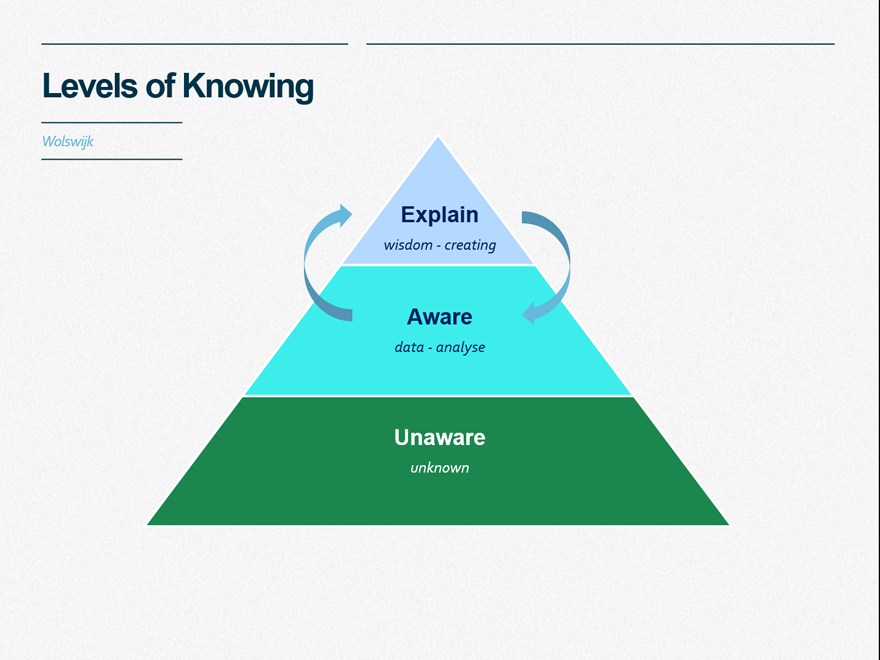
Knowledge has been taken apart many times, I believe it all boils down to the transition from, unaware, through awareness to being able to explain something. The framework below is my very own
Knowledge

I believe that first, we are not aware of what we do not know (unaware). Then when someone introduces a concept, we become aware of it and also (almost immediately) see that we can learn much more about it (being aware of what do you not know). After learning more you can start contributing and help others understand the thing you have studied (to explain it to others). This is my take on knowledge, but there are many other frameworks (listed later).

Unaware

People who are unaware will not know what is out there that they do not know. It makes me think of the proverb ignorance is bliss – that a lack of knowledge results in happiness. Yes, sometimes it is better not to think about things with very negative consequences or know about all the suffering in the world. No, this does not mean that you should not know it is there. Becoming aware of something is not always pleasant, but using it to improve a situation is – and by staying ignorant will only worsen situations.

Aware

People who are aware, are amateurs in the area they have achieved awareness in. A person who just started playing chess knows the rules and can tell what the pieces do. He does not know (and knows he does not know) how to use this data to create winning games. In this phase, people tend to overestimate their level of knowledge, because they do not fully know what they do not know (the “Dunning-Kruger effect”). At the same time he or she does know that by constantly analysing and improving, you can become an expert.

Explain

People who know what there is to know about a subject can be considered experts. A grandmaster (GM) of chess has taken the data, analysed it and turned it into wisdom. With this wisdom he or she can create winning games and new tactics. At the same time, a GM can explain this to the amateurs who are learning chess. Wisdom does not equal being good in explaining something, but they are closely related. And being able to explain your specific knowledge does also not mean you will never have to learn again, between the level ‘explain’ and ‘aware’ there is a constant feedback loop.

Examples

  1. Unaware – Most people’s understanding of quantum physics can be qualified as unaware – they have no data
  2. Aware – Almost everyone knows what different political parties stand for and what direction they want to take a country in – you have data and can analyze it
  3. Explain – Neil DeGrasse Tyson not only knows a lot about astrophysics, he also beautifully conveys and explains it to other people (making them aware)

When to Use

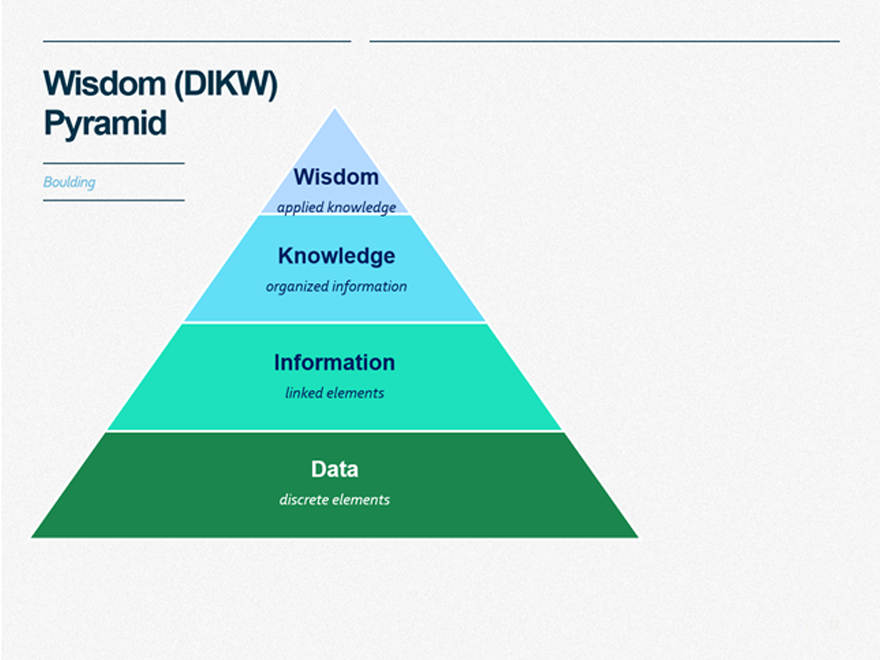
Use this framework to better understand other people. Some things that seem clear as day to you, may be wholly unknown to someone else. If you are aware of something, try and learn more, and after that make other people aware. Also, use this framework in conjunction with other frameworks (listed below) to further analyze where knowledge (or wisdom) comes from.

“… there is no shame in not knowing. The problem arises when irrational thought and attendant behavior fill the vacuum left by ignorance.” – Neil DeGrasse Tyson
More on Knowledge:

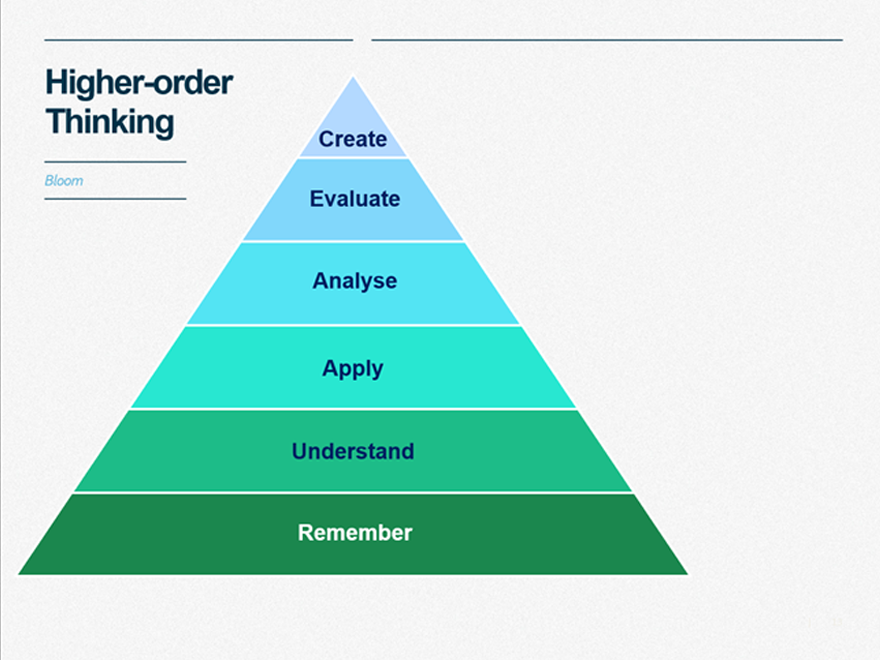
http://en.wikipedia.org/wiki/Higher_order_thinking_skills – Wiki on Bloom’s model

https://www.youtube.com/watch?v=JTvcpdfGUtQ – Vsauce on Youtube about knowledge (and not knowing)

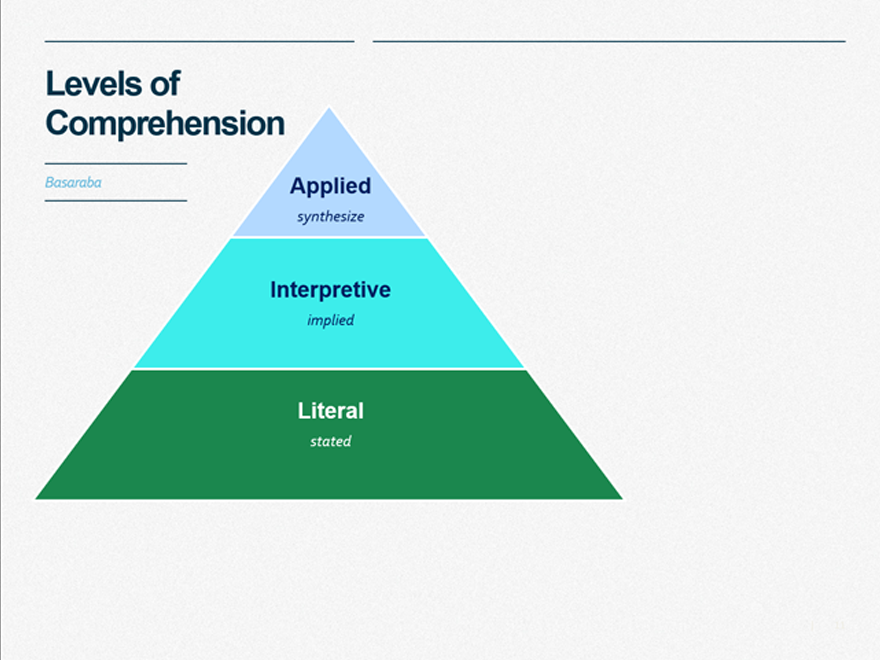
http://www.slideshare.net/marimar27/comprehension-and-levels-of-comprehension – Slideshare on comprehension
Law of the Lid

Originally posted 11 August 2014

“They were efficient managers. But they were not leaders.” – John C. Maxwell

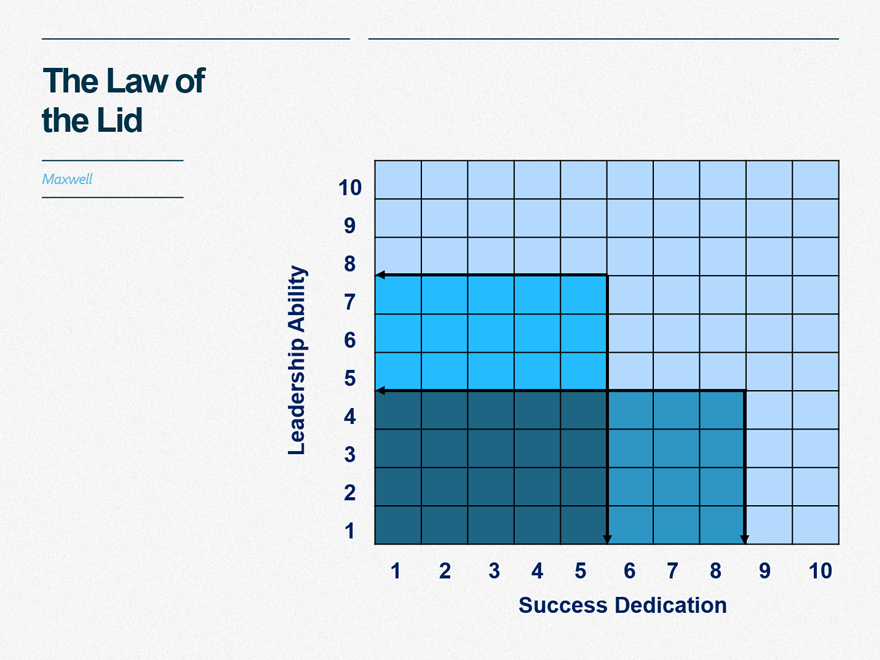
Leadership and management together define the effectiveness of an organization. Together they form the following 2×2 matrix, based on The Law of the Lid

The Law of the Lid

John C. Maxwell states that leadership ability is the lid, or cap, on your organization’s capacity to become effective. Why? You may ask. Because dedication to success (operational excellence) is easy to achieve. Developing leaders is underappreciated and more difficult.

At the same time, it is a multiplier, wherein the lower bar an increase in management will increase your effectiveness by 4 units, an increase in leadership will add 8. In the upper left the exact opposite is happening, but this scenario is quite uncommon for reasons explained below.

Management

Success dedication, or management, determines how good a strategy can be executed. In The 21 Irrefutable Laws of LeadershipMaxwell explains how the McDonald brothers were great at building their restaurant business, but not in starting the franchises that make it such an international success.

On a more personal level it means that no matter how good you are at executing your tasks and organizing your work – without leadership you will never achieve more than possible by one single person.

Leadership

Leadership ability determines what strategy needs to be followed. In The Effective Executive, Drucker explains how a leader is the decision maker within an organization. It is up to a leader to make the right decisions, at the right time. A leader makes people believe in a vision, and rigorously works to turn this vision into a reality. Where leadership is lacking teams lose, where leadership is lacking you need to improve your leadership or make way for new leadership.

Examples

  1. Bad Leadership, Good Management – Kodak in the past – it was able to be the most efficient in producing camera’s but were too late to profit from the switch to digital camera’s
  2. Good Leadership, Bad Management – Imagine a visionary within solar energy who forgets that he has to deal with governments, rules, and regulations and loses because of details
  3. Good Leadership, Good Management – Elon Musk has a vision, he knows what he wants to change, he leads effective teams and shows how together both aspects can lead to 100% efficiency

When to Use

Use this framework to evaluate your own effectiveness. Is your organization (team/group/family) listening to you, and are you taking the right route? Determine where you are still slacking and use the matrix to define where you first need to improve (the area that has the most impact). Use the framework in conjunction with the remaining 20 laws of leadership and you will be guaranteed to become more effective.

“That is why in times of trouble, organizations naturally look for new leadership.” – John C. Maxwell

More on The Law of the Lid:

http://www.johnmaxwell.com/blog/the-law-of-the-lid – Blog by Maxwell on The Law of the Lid

http://savvychicksmedia.com/topic/business/maxwells-law-law-lid/ – Blog on The Law of the Lid

http://www.slideshare.net/easyyears/law-of-the-lid-9000274 – Slideshare on The Law of the Lid

Beyond Coffee

Beyond Coffee by James Beshara.

Some overview of nootropics, and which ones you can take sustainably. Top recommendations already in Flow (our nootropic product at Queal).

Nothing much new under the sun here.

December 2019

https://thegradient.pub/an-epidemic-of-ai-misinformation/

Title: An Epidemic of AI Misinformation

A good critique of too much hype in the AI community and general public. We are still not too far along creating ‘smart’ AI and what it can do at this moment is still very limited.

Title: Carbon capture just got cheaper and more efficient

“The device, reported in the journal Energy and Environmental Science, works a lot like a battery. It absorbs carbon dioxide from air passing over its electrodes. It could be made as small and large as needed, making it easy to use at different carbon dioxide emission sources.”

I wonder if there is a Moore’s Law for the cost of carbon capture over time. It seems like it’s improving quite rapidly now.

“The system uses about one gigajoule of energy per ton of carbon dioxide captured.”

https://stratechery.com/2019/portability-and-interoperability/

Title: Portability and Interoperability

“This is about as concise a distillation of the “commoditize your complements” approach as you will see, at least as far as data is concerned: if you make Facebook better, you can have it all; if you don’t, or are remotely competitive, you are cut off.”

Or in other words, Facebook (and others) act like they give access/interoperability but only do this for non-essential parts.

https://www.forbes.com/sites/michaelshellenberger/2019/12/04/why-climate-alarmism-hurts-us-all/

Title: Why Climate Alarmism Hurts Us All

It’s real, it’s happening, but 4 billion people will not die by 2035. Quite a good read on the scientific consensus and the pain that exaggeration of this can do (e.g. kids being ‘eco-depressed’).

Title: The Science of the Butterfly Effect

Very good (and so beautifully video) about chaos (from small differences in beginning conditions).

https://80000hours.org/podcast/episodes/peter-singer-advocacy-and-the-life-you-can-save/

Title: Peter Singer on being provocative, EA, how his moral views have changed, & rescuing children drowning in ponds

The controversy around Peter Singer’s abortion standpoints helped spark new sales of his ethics book (which also talks about global poverty, animal suffering, and Effective Altruism).

“I think that EA has the potential to really transform philanthropy generally, and although there are certainly some high net worth individuals who give disproportionally a large amount of course, but still, when you look at philanthropy, say here in the United States or other countries too, the bulk of it is not just the huge donors.”

https://stratechery.com/2019/a-framework-for-regulating-competition-on-the-internet/

Title: A Framework for Regulating Competition on the Internet

“From a practical standpoint, this means that platforms should have significant latitude in mergers and acquisitions, but significant scrutiny in terms of vertical foreclosure, rent-seeking, bundling, and self-dealing.”

A more high-level analysis of regulations for both platforms and aggregators.

Title: Small rockets are the next space revolution | Peter Beck

Great intro of what Rocket Labs does and why it matters (democratization of access to space).

https://futurecrun.ch/99-good-news-2019

Title: 99 Good News Stories You Probably Didn’t Hear About in 2019

1. New surveys revealed that the population of humpback whales in the South Atlantic region now number 24,900 — almost 93% of their population size before they were hunted to the brink of extinction.

There are 98 more stats just like this waiting for you. There is still some good news out there. And we should be motivated to take action, because we can achieve good things if we do.

Title: Tradeoffs – The Currency of Decision Making

We can’t do everything perfectly, so we should focus on what we value. But we rarely do, we treat time like it’s infinite. There is always a tradeoff, know that it’s there.

https://80000hours.org/podcast/episodes/david-chalmers-nature-ethics-consciousness/

Title: David Chalmers on the nature and ethics of consciousness

These are the notes of the related podcast (80000 hours). The podcast is with David Chalmers and is about consciousness. Even some talk about eating meat (and of course that philosophers don’t always practice what they preach).

Title: Aubrey de Grey | Reaching Escape Velocity in Longevity for Most Alive Today | VISION WEEKEND 2019

Optimistic talk about how we can reach escape velocity, i.e. live forever.

https://aeon.co/ideas/richard-feynman-was-wrong-about-beauty-and-truth-in-science

Title: Richard Feynman was wrong about beauty and truth in science

“You can recognise truth by its beauty and simplicity.” is the statement of Feynman the author is going against. Ockham’s razor can be true (when two theories are comparable, the simpler might be better/true-er).

The attack on beauty focusses on the fact that beauty is something we humans say. Here I think there is a misunderstanding of the term. I think that beauty could be used as an analogy to ‘hard to vary’ or a good explanation according to Popper.

Talking to Strangers

Talking to Strangers by Malcolm Gladwell is his latest book that takes his curious look on society and applies it to interactions between people.

In it, he uses his signature style of stories to illuminate underlying principles. I can recommend the book, here are some of the principles I gleaned from my reading:

  • People default to truth
    • We need this for society to work
    • But if someone is ‘mismatched‘ then things go array
    • E.g. Bernie Madoff
  • We think we can ‘read’ other people
    • But actually this doesn’t work with mismatched people
    • E.g. Judges are really bad at using this ‘information’ from the suspect
    • Life is not life ‘Friends’ (series), we don’t show our emotions so perfectly to the world
    • E.g. Amanda Cox who was goofy, but not a murderer
  • We must recognize our inability to read others
    • And at the same time remember that our world is built on trust

From another review:

1. THE DEFAULT TO TRUTH PROBLEM We do not behave, in other words, like sober-minded scientists, slowing gathering evidence of the truth or falsity of something before reaching a conclusion. We do the opposite. We start by believing. And we stop believing only when our doubts and misgivings rise to the point where we can no longer explain them away.

2. THE TRANSPARENCY PROBLEM Transparency is a myth.

How people are feeling inside often does NOT perfectly match how they appear on the outside, which means we are misjudging other’s intentions.

3. THE MISMATCH PROBLEM We are bad lie-detectors in those situations when the person we’re judging is mismatched.

A mismatch is where someone’s level of truthfulness does NOT correspond with the way they look. I think someone is honest based on how they look and act but in actuality, they are lying and I can’t tell the difference.

4. THE COUPLING PHENOMENON The first set of mistakes we make with strangers… have to do with our inability to make sense of the stranger as an individual. But there’s a second category of error that has to do with our inability to appreciate the context in which the stranger operates… Coupling is the idea that behaviors are linked to very specific circumstances and conditions.

SO WHAT SHOULD WE DO?

We could start by no longer penalizing each other for defaulting to truth… We should also accept the limits of our ability to decipher strangers… But far more important than a little grace and humility over what we cannot do, we should be clear about what we can [do]… There are clues to making sense of the stranger. But attending to them requires humility and thoughtfulness and a willingness to look beyond the stranger, and take time and place and context into account.

End Times

End Times: A Brief Guide to the End of the World: Asteroids, Super Volcanoes, Rogue Robots, and More by Bryan Walsh is a rather entertaining overview of the end. In the book, he describes the broad categories of how we could end it all for humanity.

I found the book to be well-researched (as far as I can judge) and it doesn’t go too far in putting a number on everything (e.g. comparing the different risks).

It also isn’t too focused on technological innovation, nor on stopping ourselves in our tracks and saying that innovation is bad.

Topics:

  • Asteroids (for the first time in history we might not be done for this time, but detection is still very hard)
  • Volcano (could help with climate change, but if it’s a supervolcano/eruption, then we’re royale screwed)
  • Nuclear (can still go wrong, difficult to estimate effects of nuclear winter, probably a small group would survive)
  • Climate change (happening, maybe innovate our way out of it, carbon capture)
  • Disease (more because of better connectedness, but fewer people die of them (better health), but…)
  • Biotechnology (… we could engineer one that both infects a lot of people, and then kills them all (or just a subgroup, reminds me now of Utopia (Channel 4 series))
  • Artificial Intelligence (if goes wrong, could be very wrong, but I’m somewhat convinced by David Deutsch that if we do it, we can only do it the right way, timeline unknown)
  • Aliens (where are they, but isn’t too important subject in the book)

Overall very enjoyable and well-written. If only someone had decided not to do the voice acting (my goodness).

Breaking the Spell

Breaking the Spell by Daniel Dennett is a great exploration of religion. What it does best is ask questions, and look at religion in a new way.

Here are the parts from the wiki

Part I

Part I discusses the motivation and justification for the entire project: Can science study religion? Should science study religion?

Part II

After answering in the affirmative, Part II proceeds to use the tools of evolutionary biology and memetics to suggest possible theories regarding the origin of religion and subsequent evolution of modern religions from ancient folk beliefs.

Part III

Part III analyzes religion and its effects in today’s world: Does religion make us moral? Is religion what gives meaning to life? What should we teach the children? Dennett bases much of his analysis on empirical evidence, though he often points out that much more research in this field is needed.

He doesn’t take a hard stance (or at least not as far as I read it), but does make a great point/case for being more hostile towards religion (and teaching it to kids).

There are many more questions to be answered and I hope he has sparked some to go and find some.

The Redemption of Time

The Redemption of Time by Baoshu (translated by Ken Liu) was an awesome end to the Three-Body series. I really loved how he (another writer) brought everything together and closed many loops in the original books.

Reviews online seem divided a bit more, and focus on how the story is told. I think I just really loved how things from far earlier came back and were used again.

10% Happier

10% Happier by Dan Harris is a meditation (ghehe) on meditation and how it has helped him. Although the book is fun to read/listen to, it provides little information per page/chapter. Recommended if you’re into biographies of this kind and fun description, but read a long-form article if you want to learn why meditation is all the rage.

Human Compatible

Human Compatible by Stuart Russell is a great intro to where we are now with AI. It also lays out some of the problems and ways to tackle them.

I liked the book as a lay-person overview of where we are with AI. Stuart Russell does a great job of not looking too far ahead and also foreseeing some problems that we already have. There was no clear distinction between AI today and AGI, and that divide might be too technical/doubtful, but I (and Russell too) think the systems of today won’t get us to AGI.

See this good video om 10 reasons to ignore AI safety (and their rebuttals)

Update 17 March 2020: I’ve checked out this review on Slate Star Codex

“Russell goes over all the recent debates in AI – Facebook, algorithmic bias, self-driving cars. Then he shows how these are caused by systems doing what we tell them to do (ie optimizing for one easily-described quantity) rather than what we really want them to do (capture the full range of human values). Then he talks about how future superintelligent systems will have the same problem.”

In a way this is an analogy to a 4 year old, they will do what you tell them to do, but here are the first signs that they will do this literally and not per se as you intended them to do it.

“(from the book) The problem comes from confusing two distinct things: reward signals and actual rewards. In the standard approach to reinforcement learning, these are one and the same. That seems to be a mistake. Instead, they should be treated separately…reward signals provide information about the accumulation of actual reward, which is the thing to be maximized.

This part highlights some of the work that has already been done on solving the ‘fuck-now-the-world-is-a-paperclip-problem’.

The article also looks at how algorithms (current day AI) is doing things wrong, but concludes that in general there isn’t much to worry about. For example deep fakes have been around for some year, it isn’t being used widely (but yes, there are examples, but the same goes for forging a signature).